The eerie pull of “liminal horror” — empty, fluorescent, half-familiar spaces that feel quietly wrong — has crossed from a niche internet aesthetic into mainstream film and advertising, and brands are taking note. This issue explores why it’s resonating in 2026, alongside remote work vs. AI, thatched-roof innovation, Specsavers evolving a famous line, and the difference between writing code and shipping code.
In addition, we have ads from: IKEA, SBS, Snickers, Lime and Indeed.
// Stories of the Week:
1.) Is the Rise of “Liminal Horror” an Echo of the Pandemic?
Last week the horror film “Backrooms” became the biggest debut in A24’s history, with most of its ticket buyers under 35. Directed by 20-year-old Kane Parsons, the film grew out of the viral YouTube series he began in 2022, and it taps the internet aesthetic known as liminal space: empty, fluorescent, half-familiar rooms that feel quietly wrong and abandoned. The look is older than the pandemic, rooted in a 2019 photo of a vacant office posted to 4chan, but its narrative feels born of Covid lockdown.
“Liminal” comes from the anthropologist Arnold van Gennep, who used it for the disorientation of being stuck in the middle of a rite of passage. For a generation that watched public spaces go empty, the look and story of “Backrooms,” in which characters are trapped in endless back-of-house retail, warehouses and other slightly-off settings, are apt for what formative years disrupted by quarantine felt like. Though the film’s success is partly the result of a cultivated internet fandom, it lands because it touches a stranger nerve: a nostalgia for a disruption not even a decade gone, and a cohort lining up to feel it again.
2.) Remote Work, Not AI, May Be Young Workers’ Biggest Threat
While much has been written about AI’s impact on younger workers, new data from the US Federal Reserve lays more blame at the feet of remote work than artificial intelligence for rising unemployment on young college graduates. The Liberty Street Economics estimates 64% of the recent unemployment increase is from remote work – not gen AI – with companies reportedly reluctant to hire less experienced workers in distributed work environments. Analysis shows that young graduate unemployment is increasing faster in remotable sectors than for those in non-remotable sectors, with older workers not seeing as marked of a difference.
The proposed shift in thinking highlights two real risks to young graduates seeking jobs: first, that companies need a technological and cultural solution to build confidence in remote working set-ups and secondly, that any impact from Gen AI may still be looming.
3.) The Last Straw: What Roof Thatching Feuds Say About Innovation and Craft.
What can thatched roofs teach us about how we approach technology?
In the English countryside, a community of master thatchers is quietly at war, and the thing they are fighting over is one almost no homeowner can see. Thatching, the craft of roofing a house in straw, is more than a thousand years old, and for most of that history the material was long straw, grown in Britain and now rare. Recent decades have pushed the trade toward water reed: more durable, lower-maintenance, and increasingly imported from Europe and China rather than home-grown. To the person living under the roof, the two are nearly indistinguishable.
To a subset of thatchers, the difference is obvious, and many treat the switch as cheating, a move that renders hard-won skills and processes obsolete. The dispute has turned bitter enough to spill into physical confrontation at industry gatherings, and that intensity highlights that this isn’t really about the straw. It’s a fight about whether craft holds value a customer cannot perceive, or whether value only counts once someone beyond the creator notices it. As automation moves into field after field, the same question is coming for craft and artisans: heritage and human skill are easy to sell when recognized, but quiet traditions and implicit heritage are struggling to make a case.
4.) How Far Can You Push a Famous Brand Line?
Little in marketing is more fraught with risk than evolving a successful brand platform. Brands tend to either evolve incrementally or commit to wholesale change, and Specsavers has tried to split the difference in its latest campaign, evolving “Should’ve Gone to Specsavers” to cover a wider range of services. The line is one of the most successful in the UK, with award-winning work built on football errors, parking mishaps and misheard lyrics, all held inside the “Should’ve Gone…” platform. As the brand puts it, “to change more lives, we need to expand what people understand Specsavers to be,” so its new approach drops a problem into the line itself: “Should’ve gone to Specsavers” becomes “Should’ve gone to [problem] savers.”
That lets Specsavers speak directly to everything from home visits to eye tests. Whether the line needed to change to do it is the harder question. L’Oréal evolved “Because I’m worth it” across five decades by changing only its pronoun, from “I” to “you” to “we,” without touching the construct overall. With this much cultural equity at stake, and the risk that people keep reaching for the old line because the new one is less conversational, Specsavers might have been better off changing the meaning around the line rather than the line itself, as Mastercard and Nike have, and as Specsavers itself did with 2022’s “Should’ve 2.0.” Only time will tell whether the move unlocks the expansion they want, or whether it ends up going the way of BMW, which dropped “The Ultimate Driving Machine” and then returned to it.
// Chart of the Week: Writing Code is Easy, Shipping Code is Hard
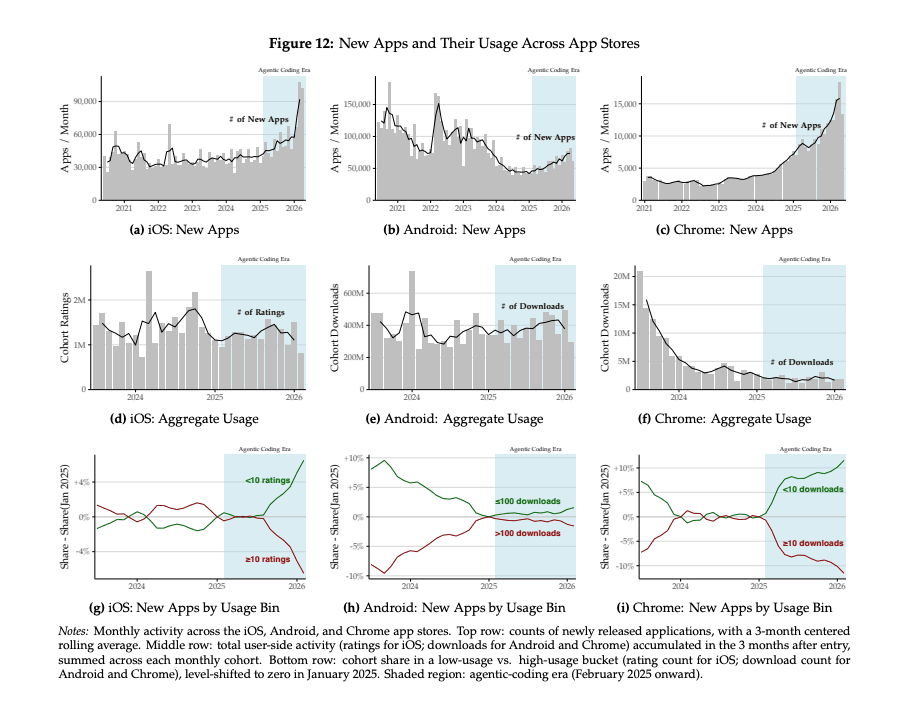
The advent of AI coding has created a boom in the amount of code written, and a sense of productivity, but what does it mean in terms of final output and usage? A new study from Demirer, Musolff & Yang (2026), shows that in an analysis of 100k GitHub developers – AI increased commits by a level of 40-180%, however the cumulative impact on actual releases was closer to 30%. Further, the impact on real life app marketplaces has been negligible, as an increase in AI augmented development hasn’t translated to a growth in users or downloads.
With Apple and others tightening vibe coded app submission requirements, we are still seeing a disconnect between AI’s ability to help us create and AI’s ability to help us offer a distinct and compelling value to others. What was true before AI is still true now. Making something is easy. Making something that’s valuable is hard.
// Ads You Might Have Missed:
1.) ‘Sweden’s Sunniest Square Meter’ – IKEA:
When the weather is hard, summer and sunlight means more. IKEA has set out to celebrate Swedish summer by crunching data and investigating weather patterns to find the country’s sunniest place. After looking at 20 years of solar data, IKEA pinpointed the spot, located on Gotland off Sweden’s east coast, and marked it with two stone arm chairs inspired by their SKARPO outdoor chair.

While it might seem like overkill to some, the campaign subtly ties together the retailer’s national heritage, outdoor discovery and product design – as well as building on previous sunlight focused work. It creates a more muted version of many of the ‘summer’s here / sunlight party ads’ previously seen in other sectors – while trying to provide different takes on Sweden’s seasons.
2.) ‘World Cup Watchers’ Rights Association’ – SBS:
With the World Cup starting in less than a week, markets in inhospitable time zones have begun to see brands take notice of the reality of watching the games live. While the US has seen Stella Artois try to make ‘Work From Bar (WFB)’ a thing and Africa’s SuperSport has celebrated a lack of sleep, Australia’s SBS has taken a stand for workers to advocate for watching the game on work time. The broadcaster has enlisted Nick Mohamed (of Ted Lasso and Mr. Swallow fame) to front the ‘Watchers’ Rights Association’, organizing Aussie employees to rally for time to watch the games vs. normal meetings and work. Acknowledging that not everyone might have that luxury (sorry doctors), the brand has taken a well trodden approach and committed to it harder than most.
3.) ‘Loved by Reeses’ – Snickers:
Snickers may be famous for its chocolate bars and for satisfying hunger, but so far it doesn’t own peanut butter like its competitor Reese’s, famous for Peanut Butter Cups and the underrated Reese’s Pieces. To start making inroads into peanut butter for its Snickers Peanut Butter variant, the brand has set out to recruit the Reese’s of the country as loyal supporters. The brand’s ‘Peanut Butter Pledge’ allows those with any variation of the last name Reese to declare loyalty to only Snickers and in return – get special rewards or even a year’s supply of the product. Coupled with a ‘Peanut Butter Focus Group’ filled with Reeses, directed by Eric Andre, the campaign continues a proud history of name trolling competitors, putting the ball in Reese’s court to celebrate any hold outs.
4.) ‘Promise Codes’ – Lime:
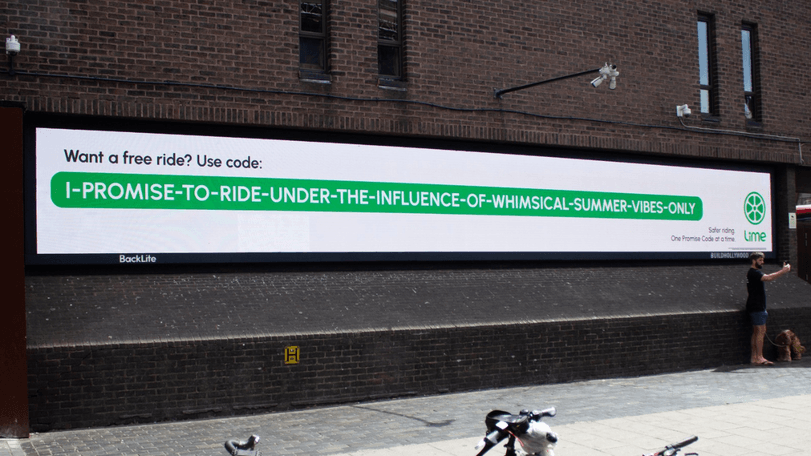
Safety messaging doesn’t often get people trying to engage with it. However, UK bikeshare brand Lime has taken a unique approach to making safety more naturally interesting. ‘Promise Codes’ features promo codes for free rides as long pledges to ride safely, with each featured in OOH around major UK cities. The codes pull double duty, giving riders a moment to think about safety, while more widely showing the public Lime’s commitment to thinking about safety – each made more effective through creativity.
5.) ‘Jobs Need People’ – Indeed:
The impact of AI on jobs is both unclear and terrifying – as companies look to save and cut headcount, while also automating much of the job seeking process. Automated Resume analysis, AI interviewers and automated analysis of candidates have all taken humanity, and humans, out of job searching. Research from job site Indeed and the Harris Poll has shown that 81% of people apply to a job and never hear back, while 45% say they have no idea if they are actually qualified for the jobs they apply for. This moment of blind employment panic has created an opportunity which Indeed looks to tap into – trying to take a warmer, empathetic tone to talking to job seekers.
Its ‘Jobs Need People’ sees a software developer, server and flight attendant shown in more human terms, in an ad soundtracked by the Alabama Shakes. Its core belief – ‘that jobs need people as much as people need jobs’ is compelling in an age of job uncertainty – but whether the brand can translate this into a functional experience that begins to tackle why that belief is so powerful is an open question. Indeed has arguably been part of the AI driven revolution in hiring, so calling out the category may require suspending belief on what’s come before it.
// Sunday Snippets
// Marketing & Advertising //
– After highlighting visibility in its last ‘Give us the finger’ campaign, Oura’s Ring 5 ads celebrate how subtle it is. [Wearables]
– KFC Sweden leans into diner’s hatred of sharing with a ‘Bucket for One’ campaign [Food]
– Liquid Death’s latest ad positions parenting as the most extreme sport on Earth [Food]
– Take9 enlists Sesame Streets’ ‘Count’ to ask people to ‘count before they click on potential banking scams [Finance]
– Irn-Bru releases their ‘We’re Made in Scotland from Girders’ anthem to celebrate the World Cup [Food]
– If you want to smell like the World Cup, Dr. Squatch has you covered with a new limited edition tournament variant [Beauty]
– How longer car ownership is remaking the auto industry [Auto]
– Kool-Aid shows why its mascot probably isn’t getting stuck in the ‘Back Rooms’ [Food]
– Fintech Cash App swaps bank cars for a magic wand [Finance]
– The founder’s fight to free Ben & Jerry’s [Food]
– Starbucks partners with Strava and introduce a weighted vest as it promotes its new RTD Coffee & Protein beverage [Food]
// Technology & Media //
– As Meta opens up its glasses to developers, some early apps have already gone off the rails [Tech]
– Eleven Labs x Hasbro have announced a partnership to allow developers to leverage licensed voices from the toy brand’s characters [AI]
– Silicon Valley is turning to ethicists and philosophers to shape the future of AI [AI]
– Developer says he’s getting threats after leaving a booby trap for vibe coders in his code [AI]
– OpenAI is reportedly pivoting ChatGPT into a ‘Super App’ before the IPO [AI]
– Dentsu’s ‘World Cup Fan Pulse’ breaks down global fan attitudes towards the upcoming tournament [Media]
// Life & Culture //
– As the Sagrada Família nears completion, a tourism backlash comes with it [Travel]
– How have movie theaters become the new wedding venue? [Culture]
– How e-motos are the “bad boy of micromobility” [Transport]
– Why is doom spending on the rise? [Finance]
– Costco is selling huge amounts of Whey protein as shortages loom [Fitness]
– Sesame Street’s Elmo has ended up on the wrong side of Knicks fans in the NBA Finals [Sports]
– Runners World investigates whether baking soda before races is worth the risk [Fitness]
– Chattanooga welcomes Spain? A guide to where World Cup teams have built home base [Sports]
– With ‘Scent Snacking’ is ‘diet culture’ coming for perfume? [Fashion]
– For those looking for a different World Cup jersey, the NFL UK has released its American football take on the England kit [Sports]
// Related Issues
– OpenAI’s “Goblin Mode” and the Rethinking of Museums
– Productivity Paranoia: Managing AI’s “Infinite Potential”
– Spotify’s “Real Fans” Bet vs. Google’s Forced AI Remixes
// Until Next Sunday
As always, let me know what you think by email (dubose@newclassic.agency), website or on LinkedIn.
You can also listen to an audio summary and discussion of each week’s newsletter on Spotify. We’re also on TikTok!