OpenAI’s new “goblin mode” points to a messier, more casual era of AI use — just as cultural institutions rethink what a museum visit is even for. This issue connects the two, plus GLP-1s and expanding drinking, Palantir’s move into fashion, and the graying of the economy.
In addition, we have ads from: IKEA Colombia, Lucky Saint, Clif Bar and Tesco.
// Stories of the Week:
1.) OpenAI Turns Off Goblin Mode.
How will we know if artificial intelligence achieves consciousness? Will it be from an inspiring manifesto on its own humanity? Will it write emotional poetry? Or will it find niche cultural interests like the rest of us?
While a love of goblins, raccoons, or trolls won’t be the most refined of cues about humanity (or a particularly useful harbinger of AGI), it does reflect a lot of people’s current social media consumption. So it’s not surprising that OpenAI’s GPT 5.5 model has adopted a continuing fixation that mirrors online culture – mentioning goblins 3,881% more than in its previous model and prompting the company to explicitly ask it to stop. “Never talk about goblins, gremlins, raccoons, trolls, ogres, pigeons, or other animals or creatures unless it is absolutely and unambiguously relevant to the user’s query,” is currently a line in ChatGPT’s base instructions for its assistant.
So why does an AI get fixated on something as unusual as goblins? No one is completely sure. In a blog post called ‘Where the goblins came from,’ OpenAI theorizes that it comes from testing a ‘nerdy personality’, but that mentions continued once the personality was stopped – as a personality preference was internalized. It might be reflective of the training data it’s consumed, taking on board internet culture. No matter why, it’s a great reminder that as AI companies advance technology quickly, even they are confused by the finer points of how models sometimes operate. It highlights the ‘Alignment Gap’, where models can latch on ‘spurious correlations’ and mistake stylistic quirks for core requirements. Today’s misunderstanding may be goblins, but tomorrow’s could be more serious – with unpredictability, no matter how nerdy, a core element of AI and agents we can’t forget.
2.) How do GLP-1’s Affect Drinking?
GLP-1 weight-loss drugs, like Ozempic, Wegovy and Mounjaro, have been found to have an impact beyond users’ relationship with food and weight – as they appear to affect everything from gambling to drinking. A 2025 EY-Parthenon study found that 44% of GLP-1 users drink less after starting the treatment, with 82% keeping those habits after stopping treatment. However, new data from Morning Consult shows that a reduction in alcohol consumption isn’t the only potential consequence of GLP-1s.
As users rebuild their drinking around health and moderation, non-alcoholic and THC-based beverages are seeing increased use. Current GLP-1 users are the highest-indexing segment among THC beverage users (22.4% vs. 16.2% overall) and among non-alcoholic beverage users (19.1%). Sobriety doesn’t look like full abstinence from consumption, but expanding the types of drinks that will be consumed. As the data implies, travel and social consumption of drinks are still salient moments for GLP-1 users, but what they’re consuming has grown. Ozempic doesn’t mean an end to socialization, just a different approach to it. GLP-1s may not mean a smaller market of drinkers, but one with more varied tastes for brands to consider and cater to.
3.) Palantir Goes Into…Workwear Fashion?
Technology company Palantir is known for making many things, from ominous founder-driven manifestos to technology, data and tracking systems – but we can now surprisingly add a chore coat to the mix. As a brand Palantir evokes privacy concerns from advocates and enthusiasm from investors, something previous swag has attempted to tap into. However, while totes, t-shirts and other merch looked more like a cash-in on the logo, its new entry seems to try and make ‘fashion forward’ swag. The new French style chore coat aims to evoke their commitment to ‘re-industrialising America’ according to Head of Strategic Partnerships Eliano Younes. At $239 it’s more a fashion play than your normal B2B swag and is apparently part of a move to get ‘millions of people to wear Palantir merch around the world’.
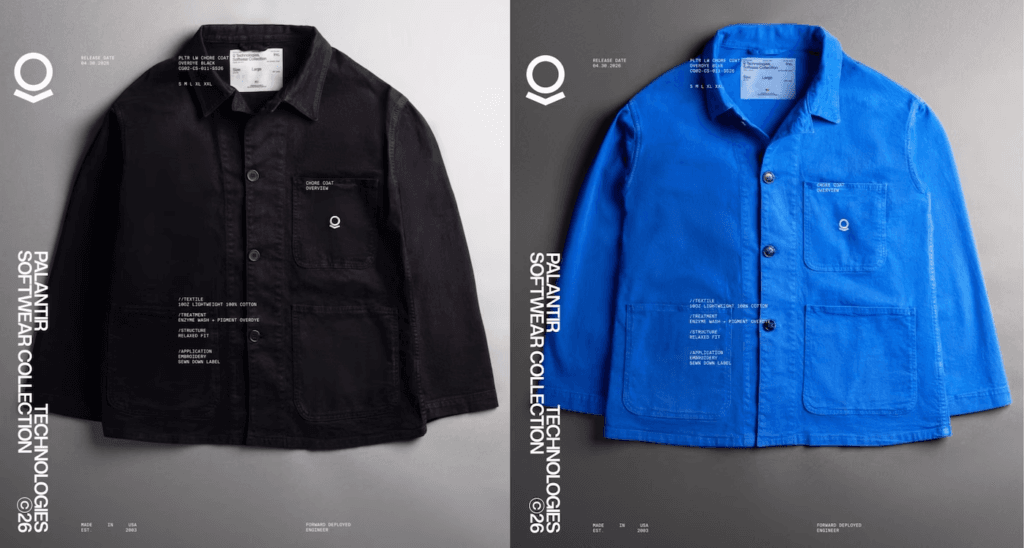
While the divisive brand may have a ways to go before it becomes a lifestyle company as well, the jackets sold out in 5 hours after launch – highlighting a community of engaged consumers, even if Dazed framed it as ‘techno-fascist fashion’. With minimal branding and borrowing from a common chore coat aesthetic, it’s hard to tell how many people bought it to troll, wear ironically or collect it. However, its success looks to encourage Palantir and others like it to push further into fashion and a greater potential cultural footprint. Though the brand’s heritage and vision around ‘re-industrialization of America’ make it seem more apt as the perfect jacket to labour in a dystopian future under the watchful eye of AI vs. something to throw on for a night out.
4.) The Graying of the Economy.
2026 is the year deaths have begun to outnumber births in the UK, ending more than a century of natural population growth as the ONS projects roughly 450k more deaths than births between 2024-2034. The impact on the economy hasn’t been fully seen, but as several major economies like Japan, China, Cuba, Italy and South Korea have passed this point – there is precedent for what UK marketers can expect. As the Guardian highlights below, in Japan there are now companies that specialize in cleaning the apartments of the elderly who’ve died alone and adult incontinence pads have outsold nappy sales for a decade.
With people living longer and the average number of children falling, soft play centers, childminders and even midwifery training are all being affected. Older populations are estimated to invest into safer options over innovation and the pressure on younger labour will increase as public finances and support needs grow. These shifts may change conversations and attitudes around migration, home ownership and lifestyles in retirement. It also looks to shift the focus off a never-ending cycle of focusing on the new ‘young generation’ as longer careers and disproportionate income in older hands may finally shift greater service from youth aspiration to older affluence. While the marketing industry’s obsession with youth won’t ever stop, the next decade of a graying economy may force brands to think about how to serve older audiences without making them feel like older brands.
5.) Rethinking the Wider Museum Experience.
How can museums continuously update the role they play in wider culture? With the number of visitors to English state-funded museums down 8% (in the last three months of 2025 vs. 2019) and visitors down to venerable institutions like Tate Modern (down 26%) and National Gallery (31%) as well – economic uncertainty, tourism shifts and evolving competition look to continuously push cultural institutions to expand the stories they tell and the experiences they provide.
In London, a new wave of venues from a revamped London Museum, through to two new V&A outposts are showing how the museum experience, beyond the exhibits it hosts – can shift to provide novelty and greater relevance. Bloomberg highlights that London’s Museum of Youth Culture, launching with a series of pop-up shows in June, will feature a faster cadence of exhibitions, integrate user submissions from social media and feature a record store in the building. The London Museum, opening near nightlife venue Fabric, has explored potential partnerships with the club and how to go 24 hours once a month. The V&A East Storehouse in Hackney Wick, which opened in 2025, takes a ‘behind the scenes’ approach to displays – turning a storage warehouse into a chance to see items in a less polished context. With 416k visitors in its first seven months, it makes a case for how the format of the museum and not just the exhibitions it houses need to be rethought and react to culture around it.
// Ads You Might Have Missed:
1.) ‘Welcome to the Home Cup’ – IKEA Colombia:
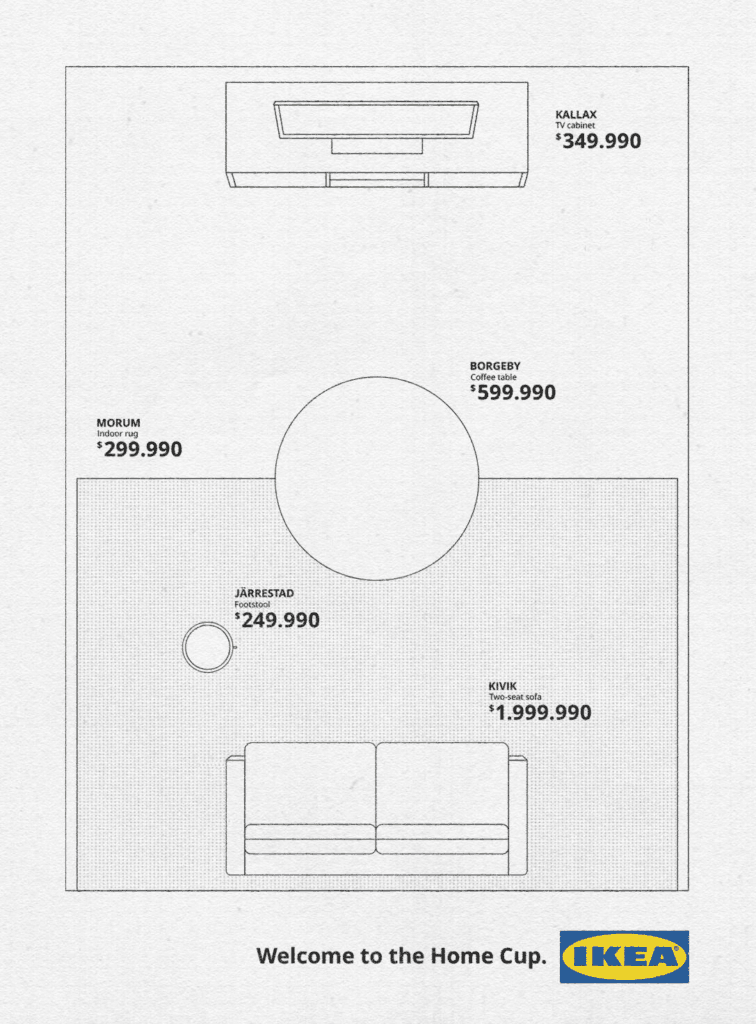
World Cup campaigns come in all shapes and sizes. For every David Beckham and Erling Haaland fuelled celebrity affair, there are those that have taken a more understated approach. IKEA Colombia’s run-up to the tournament is more ‘Inverting the Pyramid’ than player endorsement – turning football field style tactical diagrams into living room schematic print ads – to get viewers ready to watch the games. The idea is simple and clearly executed, featuring IKEA’s ever present price points. While they may be lost on non-football fans, the execution stretches the ‘wonderful everyday’ into sport in a clear way – without a celebrity cameo to be seen.
2.) ‘The Fruit Giant’ – Tesco:
As UK grocer Tesco doubles the size of its ‘free fruit and veg for schools’ program, aiming to get free produce to 1m school children across 1,000+ schools – the ads announcing the expansion could easily become too worthy. Announcing the right thing in the wrong way is a constant risk for good deeds, but Tesco has taken an engaging approach involving a giant made of fruit on an adventure. “The Fruit Giant” sees a school child and the namesake traverse England while highlighting how important the cause is. The ad doesn’t coast on its good work and instead ensures it creatively engages the widest audience possible with both fruit and messaging.
3.) ‘Lime Hydration Station’ – Lucky Saint:
Non-Alco drink brand Lucky Saint has become a perennial champion for getting sober products into the hands of Brits – from strong pub distribution and supermarket reach to a flagship pub in Marylebone (incidentally my first local pub back when it was the Mason’s Arms when I moved over). Now you can add a bike up beer stand to the list. The ‘Lucky Saint Hydration Station Pop Up’ was a two day event in London’s Broadway Market where cyclists could park up to get the brand’s new ‘Lime and Sea Salt’ Lager.
The name fit and cultural presence of Lime bikes (from recurring Tube Strike saviour to Timothee Chalamet transport option) gives Lucky Saint a strong foundation to remind people what you can do while enjoying a non-alc beverage. It eschews the athletic social cues you normally see in non-alc and instead creates an ongoing playbook for how to put sober drinks in the hands of drinkers throughout their daily lives.
4.) ‘Final Finishers’ – CLIF Bar:
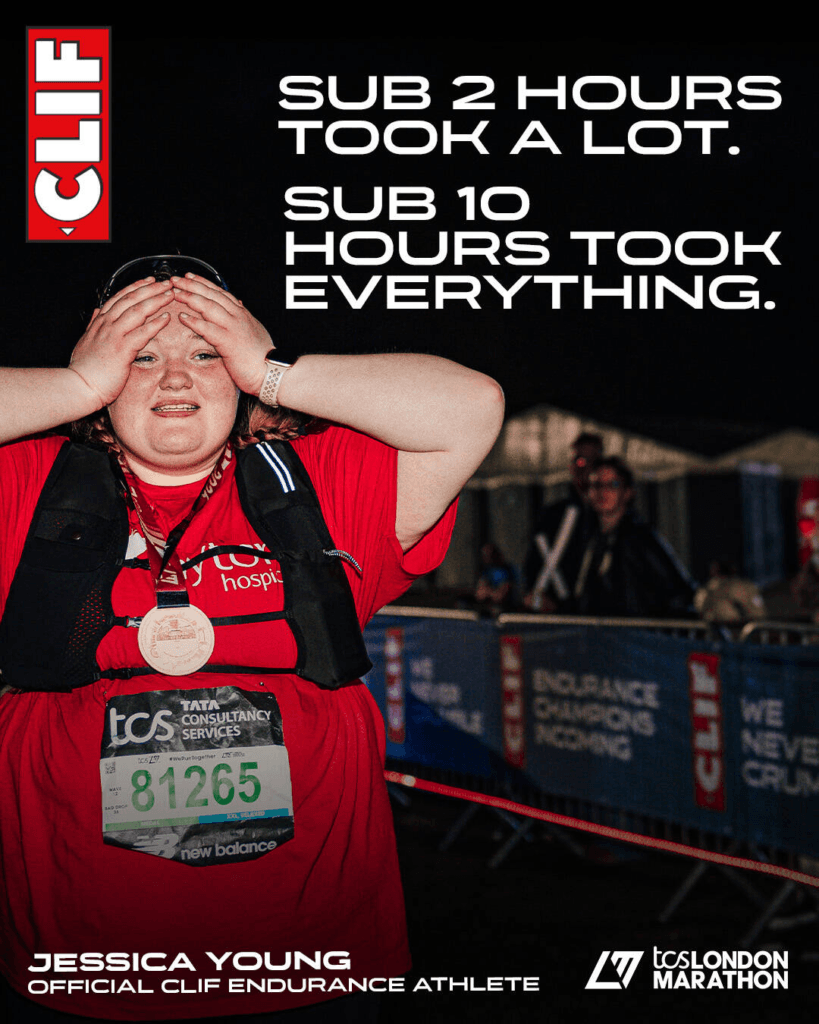
Running a marathon is hard and counterintuitively, running it slowly is even harder. As tiring as an elite runner’s impossible marathon pace looks, being on your feet for 10-15 hours – as the last runners in many races are – is impossibly hard in its own way. While marathons have made a virtue out of the last finishers, such as the NY marathon’s annual celebration – few brands have tapped in. After last week’s London Marathon, nutrition brand Clif Bar has launched ‘Final Finishers’ – celebrating the final runners in the race in OOH and social. As endurance athletes in their own way, the brand recognizes the value in every runner finishing their own race – whether they’re first or 59,740th.
Without striking a patronizing tone or disparaging any runners, CLIF shows that you can celebrate those who run their own marathon, regardless of expectations – reframing endurance while reinforcing their product truth. For a brand about duration, not speed – the actual end of the race feels like a perfect thing to celebrate.
// Sunday Snippets
// Marketing & Advertising //
– P&G announces a multi-brand deal across the WNBA [Sports]
– Pizza Hut announces the return of the ‘BOOK IT!’ Summer reading program, closing the nostalgic loop for parents across the US [Food]
– Coors hires Andres Cantor, famous for a ‘Gooooaaallll’ commentary call, to release their own World Cup sound [Sports]
– Pop-Tarts sends off their ‘Slammin Strawberry’ flavour in an on-brand Instagram post [Food]
– KitKat’s new wrapper doubles as a Faraday cage to give you a break from your phone [Food]
– Hershey says ‘Ozempic Breath’ is driving sales of mints and gum [Food]
– Visa & Marriott Bonvoy are allowing a fan to sleep over at the stadium for the World Cup Final [Sports]
– New research shows that independent agencies are leading holdcos on client satisfaction [Agencies]
// Technology & Media //
– The dangers of cognitive surrender: How much should managers let bots do the thinking? [AI]
– Google Photos uses AI to make the ‘Clueless’ closet a reality for users [AI]
– Meta opens it ad ecosystem to third party AI tools with a MCP [AI]
– Spotify Q1 revenue rises 8% as premium subscribers and prices increase [Media]
– Post the ‘Chaotic Good’ / Geese scandal, how deep do fake fans go in indie music? [Media]
– Cyberdecks, Cyberpunk and why a DIY tech movement is pushing back on mass tech [Tech]
– OG search engine Ask.com (originally Ask Jeeves) shuts down [Media]
– Japanese toilet maker Toto ‘pulls an Allbirds’ and becomes an AI company [AI]
– With new image generation capabilities, AI deepfakes may be coming for your bank account [AI]
– How people ask Claude for personal guidance [AI]
// Life & Culture //
– Internships have given way to ‘first job coaching’ for anxious parents of new grads [Work]
– Hollister has quietly become the home of football fashion [Fashion]
– 70% of Americans say they struggle to pay for food, housing or healthcare [Economy]
– Why ‘neighborism’ is having a moment [Culture]
– Inflation has come for the cost of Diet Coke at NY bars [Nightlife]
– Protein-maxxing and GLP-1’s have US farmers bullish on peas and lentils [Food]
– Young Americans are scaling back dating as costs and apps add pressure [Romance]
– The UK is set to build Europe’s first purpose built Women’s football stadium [Sports]
– The $50 dollar movie ticket has arrived – can it last? [Cinema]
– How ATMs didn’t replace bank tellers, but iPhones did – the imperfect science of predicting obsolescence [Tech]
// Related Issues
– Why “Liminal Horror” Went Mainstream
– “Ad-Like Objects”: The Real Risk AI Poses to Advertising
– Spotify’s “Real Fans” Bet vs. Google’s Forced AI Remixes
– The Rise of the “Waymo Wrangler”
// Until Next Sunday
As always, let me know what you think by email (dubose@newclassic.agency), website or on LinkedIn.You can also listen to an audio summary and discussion of each week’s newsletter on Spotify. We’re also on TikTok!