In this “Tuesday is the new Sunday” issue of Sunday Strategy, we look at five stories to think about next week, including: the data marketers feed AI but no longer believe in, Tinder measuring success by getting people off the app, Chinese seniors paying for AI family they know is fake, a requiem for the big-box third place and the return of the picky consumer.
In addition, we have ads from Beefeater, the British Heart Foundation, Fanatics, Carlsberg, The Economist & Channel 4.
// Stories of the Week:
1.) The Input Paradox: Marketing Is Feeding AI Data’s Offcuts
Marketing has a strange new habit: briefing its most powerful tools with its worst information. In WARC’s new study of 400 marketers across the US, UK, Australia and Brazil (with TikTok and LIONS Advisory), 67% say demographic data is their primary input for generative AI, while 59% also agree demographic segmentation no longer works.
The data paradox is contributing to an expected outcome: 88% report higher creative volume since adopting AI, but only 45% report meaningful quality improvement. Additionally, 87% rate their own AI use as effective, implying the fault lies elsewhere. TikTok’s global head of creative, Andy Yang, says it’s “not a technology gap, it is an intelligence gap.”
Inputs like these aren’t just outdated, they’re often wrong. CIMM found ’household-with-children’ targeting data is accurate just 42% of the time, wasting an estimated $590K of every $1M spent in campaigns, and LiveRamp simulations show identity errors alone can cut measured ROI from $1.50 to $0.43.
The industry more often describes its AI problem as a ’model problem’, a ’tooling problem’ or a ’talent problem’. However, what was true with bad briefs in advertising agencies is true here: bad inputs make for bad outputs. There’s no innovating away from that truth.
This story is part of a trend Airgo tracks: Synthetic Disappointment
2.) Tinder’s Recovery Relies On Getting You Off the App
Hinge might have famously been ’designed to be deleted’ as a brand position, but Tinder is seemingly focusing on getting online daters to ’log off’.
Tinder is expanding its in-person singles events from 10 to 26 cities by the end of September, after a Los Angeles pilot ran more than 60 events since March, engaging 66% of eligible LA users (Marketing Dive). 71% of Tinder’s eligible 18-to-24-year-old users have engaged with the pilot events, a higher rate than any older cohort, and exactly the group the app has been losing. Tinder’s US monthly actives are around 11 million, down from roughly 18 million in early 2022, and Match Group’s CEO is adapting – “We are embracing this trend of meeting people IRL… rather than hiding from it,” pointing to “roughly 250 million single people worldwide who are actively dating but are not on dating apps.”
Daters who only date offline must be worried for their livelihood as online dating apps all take aim at IRL as part of adaptation efforts. Hinge grew revenue 28% to $194M while funding real-world meetups with a $1M fund, Bumble’s paying users fell 21.1% as it kills the swipe, and dinner-party app Timeleft passed 3 million members across 200-plus cities. For Tinder, the early returns are small but directional: 30-day retention turned positive for the first time in years, including 3%+ among US Gen Z women.
For a category built on time on app, the push to IRL has made the app a necessary evil to augment. For a brand like Tinder, which saw younger daters flee the app – it seems they’ve decided to give chase.
This story is part of a trend Airgo tracks: Real-Life Antidote
3.) China’s Seniors Know the AI Companion Is Fake. They Like It Anyway.
AI slop may not look the same, or fill the same need, across age ranges. While younger users are awash in AI cats or Veggie Tales-style soap operas, older audiences are finding comfort in the slop. A demographic stereotyped as the most tech-averse is turning out to be comfortable with synthetic affection, as AI videos of synthetic singers, children and family members are providing tangible joy to older users.
Rest of World’s Viola Zhou reviewed more than 200 AI-generated “virtual family member” videos flooding Chinese platforms and interviewed users. The seniors knew exactly what they were watching and how fake it was. However, the AI content provided warmth their actual families were too busy, too distant or too gone to supply.
The value of the content wasn’t in its authenticity, but in the feeling you can derive from it. As aging populations become a greater concern for many countries and isolation increases – synthetic comfort like this looks to continue. For isolated seniors, the AI’s ability to make them feel noticed and valued is very real. The truth behind it is also applicable across ages: despite knowing something is AI-generated, if it gives us what we need, we’re willing to suspend disbelief to get it.
4.) Requiem for a Store
REI closed its SoHo flagship on Thursday, ending a 15-year run in the Puck Building that took with it 35,000 square feet over three floors, the brand’s only store inside New York City, 72 jobs, and a landmark for lower Manhattan. The consumer and cultural reaction looked less like a closure than a funeral. Highsnobiety eulogized it as “one of downtown New York’s last great third spaces.”
The grief around its closure is normally something reserved for the death of mom-and-pop or indie shops on the high street. However, as corporations begin to fill more familiar roles in our lives, from humor to interaction and lingering ’third spaces’ – even the loss of a bigger retailer hits harder.
The phenomenon isn’t limited to REI. When Joann closed all 800 of its stores last year, NPR found seamstresses crying in the aisles and Shopify measured the mourning as a buying rush, with quilting-thread demand up 200% during liquidation. However, no one from the brand ever runs an official farewell. Joann, Party City, Rite Aid and REI all exited behind liquidation banners and press statements, so customers took the memorials into their own hands: TikTok eulogies, last-haul videos, Reddit goodbye threads. Meanwhile Starbucks is still renovating a thousand stores and repositioning to reclaim a ’third space’ title others can’t pass on to it. It seems you can’t easily gain the kind of grief REI SoHo has earned, but you definitely can’t take it with you either.
This story is part of a trend Airgo tracks: Place Worship
5.) The Picky Consumer: Confidence Is Up, Wallets Aren’t Following
American consumer sentiment jumped nearly 10% in July, from 49.5 to 54.4, according to recent research from the University of Michigan (its highest reading since February) while June inflation slowed to 3.5% (the first drop in the annual rate since January). However, spending did not follow the mood change: June retail sales rose just 0.2%. Confidence is moving faster than money out of wallets – which argues for a tempered read on how marketers should interpret confidence gains.
This story is part of a trend Airgo tracks: Value-First Consumption
// Ads You Might Have Missed:
1.) ’Get More With 0.0’ – Beefeater:
It’s been thirty years since Jamiroquai’s ’Virtual Insanity’, and as one YouTube comment put it ’He’s been trying to exit that moving room since 1996’. Beefeater taps into 90s nostalgia, marks the moment and highlights its non-alc line simultaneously with a new version of the classic video.
The sequel sees what Jay Kay was reaching for all along – a non-alc drink and then builds the story further – using nine sets, treadmills and dance moves to show how you move when the gin doesn’t have any gin. The no-CG, no-AI ad, choreographed by Jay Kay himself, highlights how the walls can move after a few alcoholic or non-alcoholic cocktails. It also shows that the nostalgic well of the 90s hasn’t yet shown the bottom.
This ad is part of a trend Airgo tracks: Nostalgia Economy
2.) ’Three Minutes to Kill’ – British Heart Foundation:
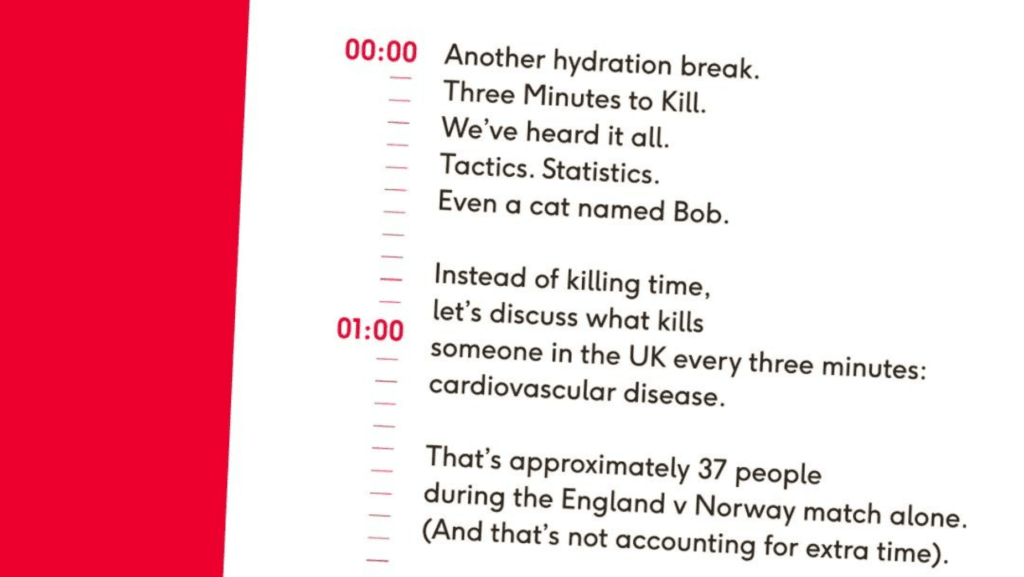
The World Cup is over, and FIFA’s mandated hydration breaks may have gone with it. However, the three minutes of dead air time that fans hated and social media joked about provided a canvas for the British Heart Foundation to make a point. Three minutes is how often someone dies of cardiovascular disease in the UK. Building on previous 3 minute ads – the campaign, fronted by cardiac-arrest survivors Tom Lockyer and Charlie Wyke, turns a cultural annoyance into an anchor for a statistic to matter more and fundraise.
This ad is part of a trend Airgo tracks: Mass Moment Sports
3.) ’We’re Still Wearing It’ – Fanatics:
Yes, the World Cup is over and yes, as you can tell – I miss it. The MLS and a gap until the Premier League have left a sense of not being ready to let it go. Similarly, Argentina fans face the potential of a team without their prolific talisman Lionel Messi.
Fanatics taps into this in an ad released after the final – championing the value of anyone wearing a jersey to say that as long as Messi’s jersey is worn, by anyone, instead of hung up – he’s not truly gone yet. Self-serving for a sports merchandiser? Yes. True that fans reliving memories around a jersey makes the moment still feel alive? Also yes. Sports merchandise advertising rarely gets to say something about grief and fandom at the same time, but this does.
This ad is part of a trend Airgo tracks: Spectacle as Belonging
4.) ’If Carlsberg Did…’ – Carlsberg:
Like all good catchphrases, it’s not up to the brand when it lives or dies. After Carlsberg retired ’If Carlsberg did…’ as a brand platform a decade ago, it seemingly carried on in UK culture – with a reported 20k mentions of the line annually. The persistence of it has pushed the brand to bring it back, with a new launch of the platform against the post-football British summer – transitioning a heritage sporting brand into wider summer activity. With it, Carlsberg (in its own words) hopes to add a ’fresh twist for today’s consumers’. The ambition may uncover another truth about catchphrases: you can’t kill them, but you can’t always make them famous again either.
This ad is part of a trend Airgo tracks: Iconic Asset Restaging
5.) ’Know it before you need it’ – The Economist:
The Economist has always positioned knowledge as the advantage against a challenging world. However, as people are seemingly given access to more information but are less prepared with insight, the publication has returned with its first brand TV ad in seven years. Pushing more than the magazine (including video and podcasts), it shows readers they can ’Know it before you need it’ – arming themselves to be ready for tough conversations. It isn’t wildly far from previous iconic Economist advertising – but its nuances (wider content sources, a switch to preparation over existing achievement and corner offices) show an adaptation for a new world.
This ad is part of a trend Airgo tracks: Paywalled Knowledge
6.) ’Ad-Free at £3.99’ – Channel 4:
Channel 4 is selling ad-free streaming in the most ad-shaped format there is. Channel 4’s latest pitch to get users to subscribe and go ’ad free’ leverages the medium it aims to kill. In a nihilistic pitch, two 90s infomercial hosts wrestle with the self-defeating reality of successfully selling the paid platform. ’Ad free’ pitches are a delicate balance for platforms, aiming to sell a free experience as good enough, while motivating people to get rid of platform-required annoyances. Channel 4 uses enough humor to distract from the paradox and in the process shows that great ads can be as great as no ads.
This ad is part of a trend Airgo tracks: Ad-Supported Default
// Sunday Snippets
// Marketing & Advertising //
– Paddy Power parodies “Get Out” to celebrate the end of Scotland’s World Cup nightmare. [Sports]
– Zevia made Cardi B a shareholder rather than a spokesperson, the latest sign talent is pricing itself as founders, not faces. [Creator Economy]
– Cathay Pacific is betting on nano-creators, trading reach for the credibility of the smallest possible accounts. [Creator Economy]
– Poppi turned a Love Island appearance into a flavor drop, parasocial product development at soda speed. [Food & Drink]
– Jägermeister let a real Argentine superstition, freezing England, do its World Cup marketing for it. [Food & Drink]
– Cheez-It and Coors Light are releasing beer-cheese crackers in August, Cheez-It’s first beer collaboration. [Food & Drink]
– Hasbro’s $600 life-size animatronic Grogu sold on pre-order, the kidult economy in a single SKU. [Retail]
// Technology & Media //
– Google is quietly handing advertisers manual opt-outs inside Performance Max, the black box conceding that trust ran out. [Advertising]
// Life & Culture //
– Spirits drinkers are trading down by format, not price: 50ml and 375ml bottles gain share while handles lose it, as US alcohol sales fall 12%. [Food & Drink]
– 64% of Americans say finding a job is harder for young adults than it was for their parents’ generation, up from 39% in just five years (Pew). [Consumer Behavior]
– Bloomberg counts the sleep-industrial complex, $3,000 mattress covers included, selling recovery to exhausted Americans who may be exhausted partly by the tracking. [Consumer Behavior]
// Related Issues
– Are Younger Singles Priced Out of Looking for Love?
– Are We All Becoming Luddites?
// Until Next Sunday
As always, let me know what you think by email (dubose@newclassic.agency), website or on LinkedIn. You can also listen to an audio summary and discussion of each week’s newsletter on Spotify. We’re also on TikTok!