In this issue of Sunday Strategy, we look at five stories to think about next week, including: the manufactured folklore of TikTok’s “Farlands,” how beer lost the Fourth of July, the misunderstood rise of the Gen Z Luddite, the first signs of Hollywood’s IP fatigue, and the promotion becoming a financial instrument.
In addition, we have ads from Anthropic, Elo, Road Safety Scotland, Dove Men+Care and the National Geographic Museum of Exploration.
// Stories of the Week:
1.) TikTok’s “Farlands” and Modern Urban Legends.
When our behaviors evolve, the urban legends we share and create evolve with them. From cursed Arcade games in the 80s to secret AI prompts to unlock new modes – new media always spurs new urban legends about secrets hiding within it. TikTok, is no exception, as an urban legend speaks about areas of the app you can’t easily find.
Named for the glitched edge of Minecraft’s map, the “Farlands” are the surreal, un-algorithmic corners of TikTok that a subculture reaches by trading obscure search codes like passwords. Creepypasta, early-internet weirdness and AI-generated imagery are being blended into a new folklore, and the point is that you cannot get there easily.
As researcher Aidan Walker puts it, “you can’t get there through algorithmic recommendation alone, you need a human to invite you in”. While the content itself is more performance art than actual secret, it shows how we continuously create and propagate urban legends, even if the media they travel in changes. Urban legends were supposed to die when everything became searchable, but human nature’s preference to assume there’s something else out there pervades despite innovation and new technology.
This story is part of a trend Airgo tracks: Tribal Gatekeeping
2.) Beer No Longer Owns the Fourth of July.
For more than a century, American beer marketing has been built on owning one day above all: the flag-waving, grill-smoke patriotism of the Fourth of July, an association brewers cultivated so deliberately that, as beer historian Maureen Ogle notes, rally-round-the-flag campaigns became the category’s default setting.
This year however, the cooler told a different story. In the run-up to the holiday, beer lost 2.6% of its volume in a single week, average consumption fell 6% across 2025 (Beer Marketer’s Insights), and while 70% of Americans still planned to buy beer for the Fourth, that number slipped two points year on year as spirits jumped seven, to 43% (Numerator).
What is filling the ice is not one rival but a swarm: hard teas, White Claw and High Noon seltzers, canned cocktails from Cutwater to Finnish Long Drink, each claiming a sliver of an occasion beer once held outright. Boston Beer founder Jim Koch saw it coming, warning the industry’s own trade groups that “for twenty years, spirits companies have eaten our lunch”. The lesson travels well beyond beer. While market share erodes loudly, in quarterly reports – occasion share erodes silently, one cooler at a time. And once a ritual slips away towards other options, it rarely returns.
3.) Are We All Becoming Luddites?
The term ‘Luddite’ isn’t normally something we find ourselves aspiring to. Used in modern culture for someone opposed to progress and technology, its initial perception may not match its original roots. The original Luddites did not hate technology, as 19th century textile workers who opposed mechanization – they feared what specific machines did to their livelihoods.
Today’s version sees the same worry. Young people aren’t abandoning the digital world, but they are rejecting the tracking, the algorithms and the effect on their social lives. Just over one in five Gen Z-ers tell Harris they wish smartphones had never been invented, while 56% of US adults now back banning under-16s from social media (Pew).
In New York, the anonymous “Summer of Ludd” festival ran eight days entirely offline, promoted only by a phone hotline, with devices put on “trial” and symbolically retired (Gothamist). Moments like this come purely from AI concerns joining long standing social media and privacy worries – 70% of Gen Z think AI will destroy more jobs than it creates (Marist). As social media bans attempt to allay part of existing ‘luddite’ concerns, are we set to see a similar reaction in AI? Until AI companies can answer growing concerns on livelihood – through policy or proving their impact is less defined as assumed, we may all start to become ‘luddites’.
This story is part of a trend Airgo tracks: Real-Life Antidote
4.) Hollywood’s Surest Brands Are Showing Signs of Fatigue.
For a decade the safest money in entertainment has been known IP: take a franchise audiences already know, extend it, and bank the opening weekend. However, this July 4th the model wobbled on the exact weekend that usually proves it. “Minions & Monsters” opened to $61 million across the five-day holiday, the weakest start in Despicable Me franchise history and roughly half the $123 million and $122 million its two predecessors banked over the same stretch (Variety). Alongside it, “Supergirl” fell 77% in its second weekend to $8.6 million, sitting at $99.5 million worldwide against a $170 million budget and projected to lose more than $100 million in theaters (Forbes). The holiday designed to showcase Hollywood’s biggest existing brands actually shrank the summer’s lead over last year, from 17% to 11.9%.
Franchises are brands, and brands can be extended until they fatigue. FMCG marketers learned this with line extensions decades ago: each new variant borrows equity from the parent and returns a little less, until the brand stretches too far. Movie IP may be hitting the same wall, as “pre-sold” stops being a differentiator when every studio’s answer to risk is another installment, and familiarity gets repriced from guarantee to commodity. The question for every IP owner is whether this summer is a blip, or the moment the pre-sold premium started to expire in the face of media fatigue and saturation.
5.) Brands Offer Consumers Arbitrage.
“If the team wins, it’s free” is one of retail’s oldest theatrical moves, and its economics have always lived somewhere between courage and an insurance policy. Sportswear brand Forme just showed what the modern version looks like. For five days around the USMNT’s knockout run, the code “Team USA” promised a full refund on purchases if the US reached the World Cup final. Forme paid promotions platform PlayAbly an underwriting fee, PlayAbly hedged the payout risk on prediction market Kalshi, and the promise drove four times the usual menswear traffic and nearly twenty times the traffic to its top styles. The US lost to Belgium, nobody was refunded, and as Forme’s VP of finance put it, “we’re basically the pioneer testing this concept” (Modern Retail).
In June, NYC Upper East Side bar The Jeffrey promised $100 tabs if the Knicks took Game 1 of the NBA Finals, put $5,000 on the Knicks on Kalshi at an implied 37% chance, and when they won paid every tab out of a $13,500 return, having eaten a $4,000 loss on an unhedged promotion weeks earlier (Fortune). It is the self-serve version of what big retail has enjoyed. Jordan’s Furniture insured its “free if the Red Sox win” refunds in 2007, roughly $35 million paid to more than 24,000 customers, and insured this year’s $50 million UConn promotion the same way (“Whether they win or lose, I got to pay for the insurance,” per retired president Eliot Tatelman (WBUR)). Houston’s Mattress Mack placed around $10 million on the 2022 Astros and collected a record $75 million, expressly to fund his own double-your-money-back refunds (ESPN). What once required an indemnity insurer’s underwriting desk is now a market order on a prediction platform trading at a $178 billion annualized run rate and pitching itself to businesses as, in Kalshi’s words, “business insurance” (TechCrunch).
This story is part of a trend Airgo tracks: The Crapshoot Appeal
// Stat of the Week: The “AI Tax” Has an Age Distribution
New US research from SegmentOS puts a number on the authenticity mood. 59% of 18-to-28-year-olds say they have punished a brand for using AI in the past six months, a figure that falls steadily with age to just 18% of those over 61. The same study finds 68% of consumers would choose a “human-made” product over an “AI-made” one at the same price, 54% would pay a premium for it, and 47% say they lose trust in a brand the moment they discover its copy was written by AI. The preference for the real is no longer a weak consideration. It is a measurable price, and it is the youngest and wealthiest customers who are charging it.
This stat is part of a trend Airgo tracks: Human Detection Premium
// Ads You Might Have Missed:
1.) ‘Inviting Hard Questions’ – Anthropic:
Most AI marketing either sells the dream or hides the technology. The halcyon vision of AI in marketing may be ending. Anthropic, working with Mother in London, built its new campaign around a film of real people voicing their hopes and fears about AI, from job loss to misuse, then opened a public platform inviting anyone to submit their hardest questions and pledged to track its answers in public. With 60% of consumers saying “AI” in brand messaging is a turnoff, advertising the discomfort itself reads the room better than another demo reel.
This ad is part of a trend Airgo tracks: AI Safety Theater
2.) ‘Any Step Counts’ – Dove Men+Care x Strava:
To relaunch its reformulated 2-in-1, Dove Men+Care built a Strava challenge that rewards any movement rather than speed, drawing more than 16,000 participants to their ‘Any Step Counts’ challenge (Marketing Dive). The brand’s more inclusive tone, on a platform normally built for PRs and timing is an intriguing shift that taps into a more inclusive view of fitness.
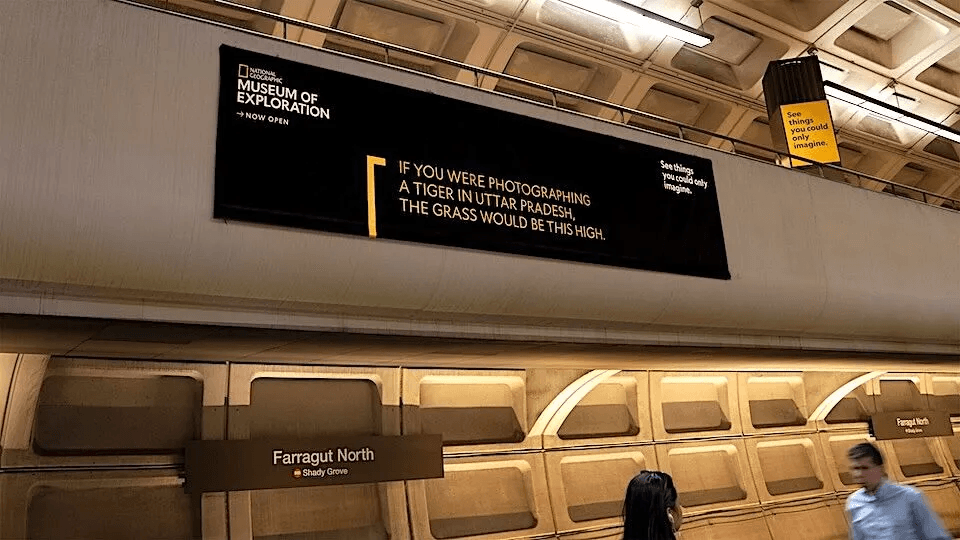
3.) ‘See Things You Could Only Imagine’ – National Geographic Museum of Exploration:
Museums should capture the imagination of visitors and National Geographic’s latest campaign directly inspires wonder in the modern world. “See Things You Could Only Imagine” prompts people to think about the height of the grass in a savannah or the size of a dinosaur, anchoring them to real world objects and moments.
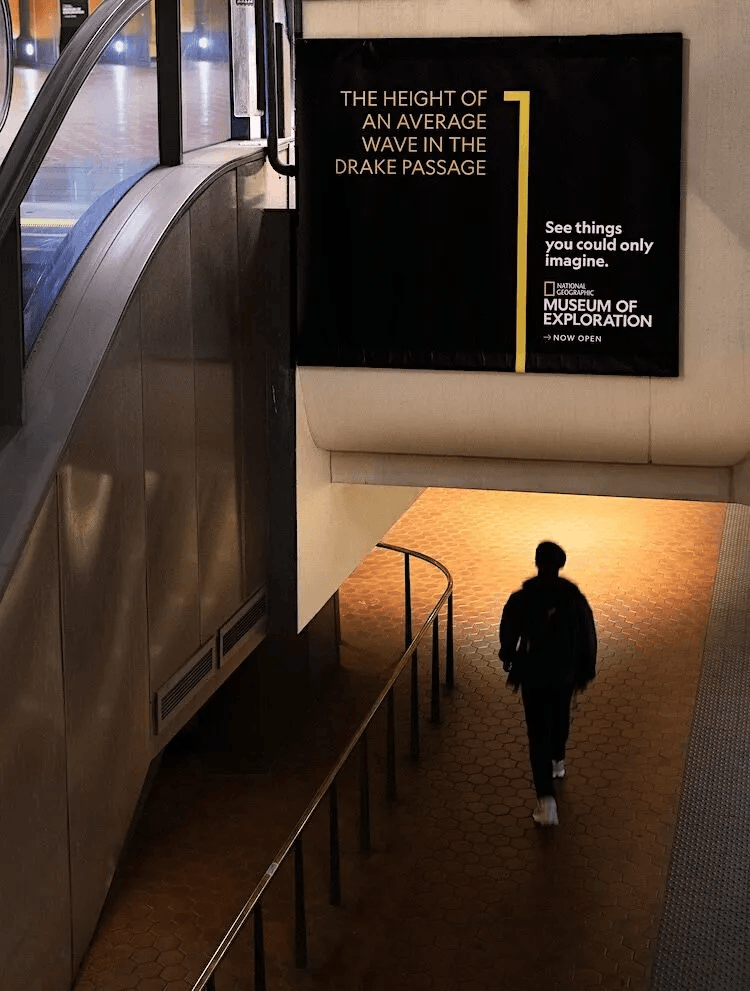
The simple mechanism captures the value of the museum and the wonder of the natural world in one execution – showing that we go to museums to imagine, not just learn. For a sector that struggles to engage a wide swatch of the population in culture, the campaign shows that when you reduce your messaging back to its core essence, you don’t have to do much to capture a potential visitor’s attention.
4.) ‘The Road is Calling’ – Road Safety Scotland:
Can a motorcycle safety video feel like a car ad? Road Safety Scotland’s latest PSA feels more like a Jaguar ad or a tourism video than one about road safety. Asking bikers to focus and prepare for driving along Scotland’s beautiful, but sometimes tricky road ways – the ad takes a cinematic art direction and applies it to a more quotidian message.
5.) ‘The King’s Last Letter’ – Elo:
Despite an exit from the World Cup, Brazilian payment technology company Elo has taken the moment as an opportunity to reach Brazil’s football fans and further position itself as the ‘the card of Brazilians’. The ad, which features football legend Pele’s last letter, offers a message of shared faith, hope, and resilience – while pushing Brazilians to unify around the team’s future. Though the brand has to struggle with the disappointment of a tournament exit, it turns it into a moment to champion and associate with national pride through the words of one of the country’s sporting icons.
This ad is part of a trend Airgo tracks: Heritage Storytelling
// Sunday Snippets
// Marketing & Advertising //
– Marmite renamed itself “WeMite” for England’s World Cup run, complete with a US “smuggling” stunt [Sports]
– Del Monte offers free haircuts to the Wimbledon queue on opening day [Sports]
– Maple Leaf Foods rebadged its “Top Dogs” pack as “Under Dogs” for Canada’s knockout run [Sports]
// Technology & Media //
– New job titles and shifts are creating what Time calls the ‘Tech Bro-ification’ of marketing [Tech]
// Life & Culture //
– 54% of people now say everything looks the same, a “hyper-blanding” that AI is accelerating [Culture]
// Related Issues
– Dopamine Shopping vs. Gamifying Purchase
– Can Cannes Keep Up with AI Creativity?
// Until Next Sunday
As always, let me know what you think by email, website or on LinkedIn. You can also listen to an audio summary and discussion of each week’s newsletter on Spotify. We’re also on TikTok!