In this issue of Sunday Strategy, we look at five stories to think about next week, including: performative purchasing, the brand impact of AI search, AI’s value divergence, Buc-ee’s diplomacy and Golden Girls’ housing.
In addition, we have ads from: Tennent’s, KFC, Volkswagen, Visit Halland and Tango.
// Stories of the Week:
1.) The Age of Performative Purchasing.
A wave of “dopamine sites” shopping websites like FoodNeverComes lets you browse, add to cart, check out and watch a courier approach – despite food never arriving. It may seem like a gag, but the hit of dopamine from modelling online behavior is real. Post capitalist joke or a novel solution to economic concerns in an age of online shopping?
The sites follow how we buy now, with TikTok Shop reportedly hitting $15.82bn in 2025 and growing, alongside Temu’s gamified engine of discount games and countdown timers. With 81% of US shoppers making impulse purchases – and 62% regretting one – the ability to hit the buy button may be more important than what arrives. The ritual before the product gives some pleasure even if it doesn’t tangibly pay off. Similar to lottery tickets, the process of anticipation holds its own value. Now, it can’t be too long until someone figures out how to do an unboxing video for a product that never arrives.
2.) Does AI Need to Share Our Values?
Artificial intelligence and LLMs are only as substantive as what they’re trained upon and this collection of news, cultural models and data offers a view of society, but it doesn’t necessarily mirror it. Analysis by the Economist of AI models, using the World Values survey, highlights that most AI models are more secular and liberal than the populations they serve – with the exception being Chinese created models.
The divergence of values across user & AI isn’t surprising – AI isn’t human and offers an impression of what we think collectively as society. Deeper values and cultural beliefs are messy, contradictory and hard to quantify as humans, let alone for an AI model. However, as more people look to them for everything from medical and relationship advice to religious guidance – the appearance of values and beliefs gives AI answers an outsized appearance of relevance and authenticity. Understanding that AI represents a snapshot of what it believes society thinks, and not an actual belief system or view, is important when considering any AI answer.
The danger isn’t that AI holds the wrong values. It’s that its fluency makes any answer sound like a held one. AI might be an unlikely philosophical opportunity to not just interrogate artificial values and answers, but those we hold ourselves. As we think more about how AI’s ‘values’ are shaped, we should consider how our own are formed and how strongly we hold them. Studies like this shouldn’t make us want AI to be a mirror of society’s values, as much as a mirror that could prompt our own interrogation of what we personally believe.
This story is part of a trend Airgo tracks: Unverified Authority
3.) Thank You For Being a Friend: The Turn to Golden Girls Housing.
While the 1980’s sitcom ‘The Golden Girls’ was surprising for several reasons at launch, including the fact that several of the actresses were actually in their 50s – the living situation of four elderly friends living together is rapidly becoming a modern reality. As economic uncertainty grows and retirees face new ways to ‘age in place’ vs. moving, home sharing is on the rise. Alongside multi-generational households, more older people are taking on roommates and in the process, creating infrastructure to find and manage the arrangement.
The shift trades the traditional dream and challenges of retirement for autonomy through cohabitation. With longer life spans and rising costs, the traditional dream of a ‘golden retirement’ is often tinged with the reality of assisted living or uncertainty – surprisingly fixed by a ‘Golden Girls’ style solution.
This story is part of a trend Airgo tracks: Platonic Primacy
4.) The Downstream Impact of AI Search Visibility.
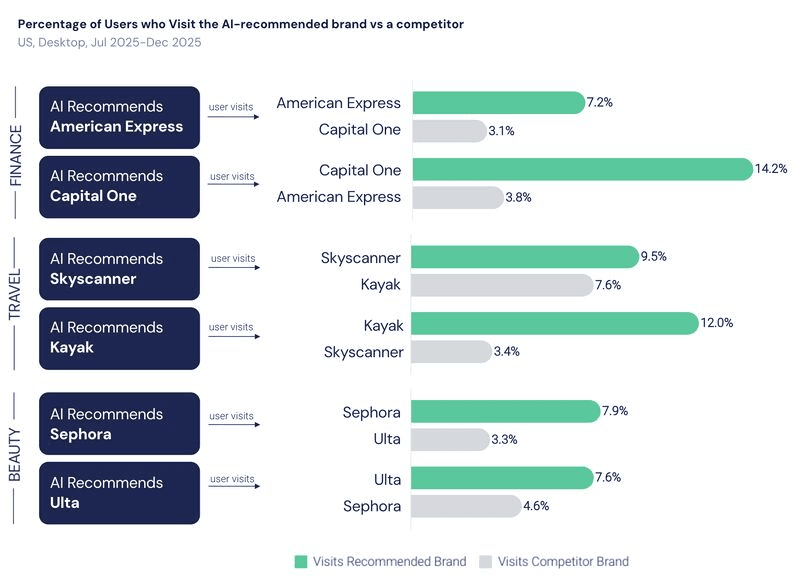
The impact of AI search on brands may extend further than the initial click. A study from Similarweb has found that users were 2.5x more likely to visit a brand after receiving an AI recommendation. Looking across desktop users in the US searching for finance, travel and beauty brands – the study found those who asked ChatGPT a query and received a branded response were more likely to visit that site within 7 days. AI isn’t just driving immediate behaviour, it’s influencing downstream action.
This story is part of a trend Airgo tracks: Agent-Legible Branding
5.) How Powerful is Buc-ee’s Diplomacy?
As the World Cup carries on, football fans are posting odes to the American suburb. While we’ve written about the potential for a TikTok about Buc-ee’s or Boston’s dalliance with the Tartan Army to shift opinions, which force wins between suburban wonder and US geopolitical chaos?
A Spring 2026 Pew research survey shows the country may have a long way to go to turn a corner at the World Cup. 57% of those in 36 countries say they hold an unfavorable opinion of the US and 66% believe the US doesn’t take other countries into account. While a large soda or free nachos are impressive in some ways, they may not counteract the view of the US as insular or indulgent. Instead, the ‘Buc-ee’s Diplomacy’ of this tournament playing out in social media may leave a two tier view of the US – a great place to get BBQ but a persistently untrusted trading partner.
This story is part of a trend Airgo tracks: Diplomatic Spectacle
// Chart of the Week: Where AI Search Gets Its Answers
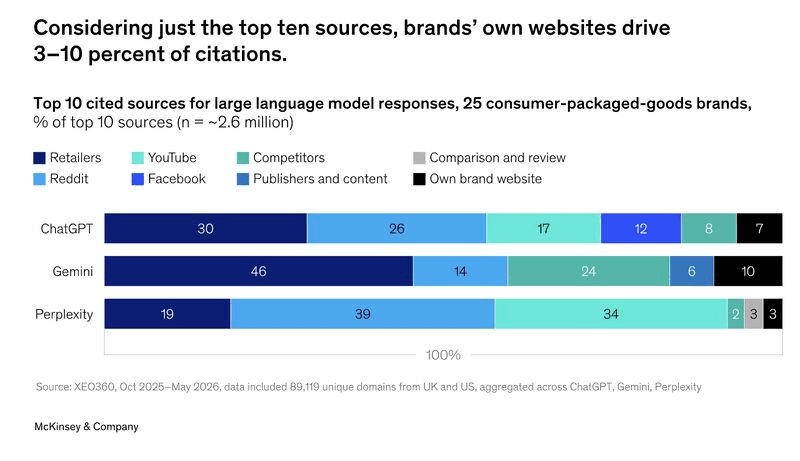
McKinsey’s 2026 AI Discovery work finds that a brand’s own website accounts for only 5 to 10% of the sources AI search engines cite; the other 90-plus percent comes from publishers, retailers, review sites, Reddit and other third parties. The same research puts roughly half of US consumers already using AI search and projects $750 billion of US spend flowing through it by 2028. The takeaway is uncomfortable for anyone who built a decade of SEO around their own domain: you cannot optimize your way to the top of an answer you barely source. The job is broader than just publishing content and creates an ongoing opportunity for PR and marketing to help build authority off site.
// Ads You Might Have Missed:
1.) ‘Finger Lickin’ Fourth’ – KFC:
When you care about fingers, the fireworks filled 4th of July is an annual risk whether you’re the local ER or KFC. To prove its continued commitment to being ‘Finger Licking Good’, the brand has partnered with Jackass’ Johnnie Knoxville to let you know how to safely enjoy the holiday and keep your fingers on July 5th. The ad combines a brand that constantly expands its elements, with a cultural moment and their spokesman’s new movie launch for something that sells chicken alongside safety.
2.) ‘Wrecking Ball of Tang’ – Tango:
Backed by a £2.7m push, Tango brings back “You Know When You’ve Been Tango’d” for the first time in 24 years, swapping the vintage happy slapping gag for a wrecking ball to dramatize the flavour. The ad works if you don’t know the original, still using stunt to drive home flavour experience, but if you’re familiar with both it works harder. It is a lesson in reviving a dormant distinctive brand asset, while still making sure that the message goes further than advertising nostalgia.
This ad is part of a trend Airgo tracks: Legacy Leverage
3.) ‘Langevity’ – Visit Halland:
Between GLP-1s, Biohacking and Peptides – internet culture would have you believe that wellness and longevity is found online or in a supplement brand. However, Visit Halland, the regional tourism board of Halland in Sweden, would like to provide a dissenting opinion. The brand’s new tourism campaign wants you to switch cryo-therapy for a cold swim or peptides for a day outside – all while selling the region’s attractions and beauty.
To add a point to it, the campaign anchors against longevity therapy’s most notable enthusiast, Bryan Johnson. The personal call out looks to bait and amplify, but as longevity becomes a greater cultural fixation, it’s an open question if this addition is needed. The campaign’s end aim – to drive awareness of the region’s lifestyle and attractions is on show, as long as the full breadth messaging strategy can quickly get out of the way around it.
This ad is part of a trend Airgo tracks: Real-Life Antidote
4.) ‘The Day After’ – Volkswagen:
Tiredness around the World Cup is a common theme, from South African DSTV to Australian SBS, but Volkswagen Germany has taken a more subtle approach to talking about late night German World Cup games. “The Day After” features shots of morning shortcomings after late nights of German football, from missed buses to stolen coffees – all with subtle jersey and face paint shots fading after a night of sport. The ad’s key message, that the brand’s safety features will watch your back after you watch the football is deftly delivered – even if nights of German football have already come to an abrupt end.
This ad is part of a trend Airgo tracks: Mass Moment Sports
5.) ‘We’ll Dream Again’ – Tennent’s:
Speaking of World Cup exits, Scotland’s exit at the group stage didn’t just deprive other North American cities of a chance to party with the Tartan Army, it brought to an end the World Cup ‘dream’ championed by Scottish beer brand Tennent’s. Fronted by Scottish ‘Game of Thrones’ actor Rory McCann, the campaign started a month ago with a force that implied expectations of a longer run.
However, after losses to Morocco and Brazil, Scotland’s exit has seen a final ad in the campaign – pushing Scotland fans to take a moment to appreciate what did happen before turning to 2028’s Euros. Beer brands and sport often focus more on the celebration than the commiseration, but Tennent’s campaign – seemingly shot completely in the back of a Glasgow pub shows that when the dream is unlikely, celebrating its inevitable end is still worthwhile.
// Sunday Snippets
// Marketing & Advertising //
– What happens when AI puts Gen Z in the C-suite? [Business]
– Starbucks is turning its baristas into a paid creator network on TikTok with ad-revenue sharing [Social Media]
– everyday people and Thinkbox built a framework to measure which media most shape culture. Surprisingly TV ranked first [Research]
– Tide already owns detergent, but now it’s shifting to grow tiles [FMCG]
– Mountain Dew marks 80 year anniversary with 5 cent bundles [Drinks]
– HBO Max flies a dragon over London to launch ‘House of Dragon’ season 3 [TV]
// Technology & Media //
– Wearables that track sun exposure are aiming squarely at the sun-care market [Tech]
– Google’s AI Mode passed 1 billion monthly users a year after launch [Search]
– Anthropic’s Claude design tool is creating new web-design clichés [AI]
– Meta’s Brain2Qwerty offers a non-invasive way to translate brain activity [Tech]
– REI gets roasted and caught up in the ‘AI Slop’ debate [AI]
– A24’s partnership with Google to develop AI film making tools is polarizing [AI]
// Life & Culture //
– Skechers is bringing back a Y2K classic for a new generation [Fashion]
– The Gen Z ‘Glow Down’ is real [Culture]
– Breaking Down the ‘Glitchy, Gloppy’ Look of Now [Design]
– Is Canada’s World Cup secret weapon… the game mafia? [Sports]
– More workers are ‘micro-shifting’ [Work]
– Gallup breaks down American attitudes towards the moral acceptability of different behavior [Culture]
// Related Issues
– Can Cannes Keep Up with AI Creativity?
– Will the World Cup Shift Attitudes About America?
– The “Friendship Economy”: Brands Selling Connection
// Until Next Sunday
As always, let me know what you think by email (dubose@newclassic.agency), website or on LinkedIn.
You can also listen to an audio summary and discussion of each week’s newsletter on Spotify. We’re also on TikTok!