In this issue of Sunday Strategy, we look at six stories to think about next week, including: Cannes & AI Creativity, Adult Summer Camps, Google’s Search Profiles, London’s Double Marathon, The False Short King Summer and When News Becomes Social Opinion.
In addition, we have ads from: Lyka, Heinz, Polymarket, IKEA and Etsy.
// Stories of the Week:
1.) What Does Cannes 2026 Say About the Awards, AI and Creativity?
As Cannes Lions International Festival of Creativity kicks off on Monday, the festival is facing a 25% decrease in award entries YoY, ostensibly due to a tightening of ‘integrity rules’ after controversy during last year’s awards. 2025 saw Brazil’s DM9 return its Creative Data Grand Prix and 11 other Lions after using AI-altered footage (including CNN campaign coverage), which drove changes from a dual layer fact checking system, a new ‘integrity council’ and bans of up to three years for agencies that submit deliberately misleading work. An industry that faces questions around how to authentically use new technology sees its awards also wrestle with the same issue.
However, this year’s festival sees greater shifts towards acknowledging AI’s impact beyond award submission quality. Cannes is introducing the ‘Creative Brand Lion’ that rewards brands who ‘consistently produce exceptional work through strong internal systems, culture and capabilities’ – trying to show the wider organizational impact of creativity, as well as a refresh of the Data Lions and new AI generated categories. Naming where AI craft can live, while also trying to cast the net wider on rewarding creative culture seems to recognize changes in creativity overall thanks to new technology.
In a market of greater AI creativity, craft (both human and AI) can be separately appreciated for its own value – as long as it is authentically disclosed, evaluated and discussed. When creativity is augmented by technology, culture becomes more important and should be recognized. Cannes 2026 seems to be setting the groundwork for evolving conversations about creativity in the years to come – the question will remain if the industry is ready to join in.
2.) The Growth of Adult Summer Camps.
Adults are going back to summer camp as organizations like “Camp Social”, “Camp No Counselors” and “Camp Chateau” offer a combination of escapism, nostalgia and belonging. The increasing pressure of everyday life, from constant obligations to being ‘always on’ at work have created a greater value in the idea of somewhere you can switch off and escape. This couples with the sense of childhood as a ‘simpler time’ – even if you didn’t go to camp as a kid.
Most powerfully though, these camps may offer a sense of social connection adults aren’t finding in everyday life. The impact of ‘friendship recession’ in middle age and greater isolation through remote work has created a need to find new ways to connect with others. The camps aren’t selling a week off. They’re selling the friendships adulthood stopped supplying, and charging admission for what used to be free. Camp Social builds on this with claims that ‘99% of people arrive solo, 100% leave as friends’. However, can the reality of these camps deliver on the expectation or are there problems that even a week in the woods can’t fix?
3.) Google Leans Into Disruption with Creator Search Profiles.
Google has announced ‘Search Profiles’, a dedicated public profile letting creators showcase content across Google Search and Discover, available initially in the US to creators exceeding follower thresholds across YouTube, Instagram, X and TikTok. With AI already shifting search behaviors towards the interface and younger audiences using social search alongside Google, the move shows how Google would rather host the forces disrupting traditional search vs. fight against it.
4.) Is London Marathon’s “The Double” the Future of Races?
The 2027 London Marathon has announced that next year’s edition will feature two races instead of one, welcoming 100k to run the streets of the UK capital. Already voted the number 1 marathon brand in the world, and the world’s largest 1 day annual fundraising event, “The Double” looks to significantly increase the race’s cultural and charitable impact. However, with 1.3m people entered in the ballot for next year’s race, doubling capacity still only keeps the odds of a place in the single digits.
It also signals the state of the current running event market – as larger majors are seeing increased demand while smaller races are having to adapt and innovate (as seen with Bandit’s Grand Prix) to keep pace with runners looking for larger milestone races. The shift to a weekend of running, even if only for a year, turns the London Marathon into a two day festival and a longer cultural moment (similar to Hyrox and others). The ‘one off’ message around ‘The Double’ looks to increase pressure to participate even further – pushing next year’s race to the forefront of the running calendar.
5.) The Deceptive Rise of the Short King
How far have ‘short kings’ really come? Despite cultural discussion about the appeal of shorter men in heterosexual relationships, celebrity relationships with shorter men and taller women like Tom Holland and Zendaya and even a 2022 period dubbed ‘Short King summer’, height difference may still cut against shorter men in relationships. An analysis shows that despite the positive noise, there may be a ‘smaller’ impact. Data already shows that men who are 6’3’’ receive 60% more messages on dating apps than men who are 5’7’’ (the alternative being true for women).
Data from America’s Panel Study of Income Dynamics continues to show that men and women sort traditionally by height, as only 3.3% of US couples see the woman taller than the man (half of what random distribution would see). While the amount of couples where the woman is at least two inches taller than the man increased from 1.4% to 1.9% between 2017 and 2023, most couples still see taller men than women. “Short Kings” may be an example of a cultural ideal we buy into more widely, but don’t practice in our own lives and dating.
6.) The Socialization of News Into Avoidable Opinion
Reuters’ ‘Digital News Report’ for 2026 shows that news has increasingly become socially led, with more than half of younger audiences (54% of global audiences / up 3% YoY) using social media as their primary source of news – overtaking TV and news websites. This shift has led to the snippeting of information, with short form video increasing YoY as a source of news (Instagram +11% and TikTok +16%).
As news becomes more social, our relationship with it also changes. 42% of people say they often or sometimes avoid the news, with 63% of Croatians and 60% of the Turkish population agreeing. Trust in news is also eroding, as 37% of people globally say they trust news most of the time (down 3% YoY). Only Germany, Singapore, Japan, Spain & Kenya increased their trust in news in the last year. The shift from singular push news sources to a wider democratized, social news base has arguably made news less trusted and easier to ignore – taking it as an uncomfortable opinion in content vs. information.
// Ads You Might Have Missed:
1.) ‘Shop Other Jeffs’ – Etsy:
The billionaire class is an easy target in political and social advertising, but often more difficult for brands to use as a foil. Etsy’s latest ad threads that needle deftly, taking aim at a certain Jeff from Amazon without mentioning the word Bezos. Etsy’s ‘Shop Other Jeffs’ implores customers to shop with one of the 5,000 non-billionaire Jeffs on the platform – using economic class struggle as a way to drive home their DIY and craft position. Etsy has always implicitly fought against the ‘Other Jeff’s’ convenience driven empire, but with a smart shift – they’ve made it more personal just in time for Prime Day.
2.) ‘Assemble the World’ – IKEA Canada:
IKEA Canada has shown that World Cup ideas don’t have to be complex with their latest campaign. “Assemble the World” makes shoppable flags out of IKEA products, allowing the brand to comment on a certain football tournament without encroaching too far on sponsor territory. The use of product makes a cultural moment into a product one, something IKEA has done deftly across the globe in recent years – from other sporting ads, to seaside OOH and summer chairs in Sweden’s sunniest square meter.
3.) ‘Questions Are Everything’ – Polymarket:
Prediction market brand Polymarket has launched a new US campaign during this year’s World Cup, featuring music legend, and quasi-mystic figure, Rick Rubin. ‘Questions are Everything’ leans on Rubin’s persona as a commentator on creativity and understanding to position prediction betting as an act of investigation and exploration. With versions asking questions about whether MENA peace will be found, whether the US can win the World Cup or whether it will rain – the brand attempts to elevate its offering against competitor Kalshi’s more basic ‘name recognition’ activity, currently featuring Timothee Chalamet as a spokesperson.
Whether anyone buys Polymarket’s gamble is questionable, but it does show a point of difference in positioning against its largest competitor, while also telegraphing some concerns about future regulation. The media placement, during this summers’ largest sporting event, regrounds the lofty strategy in the world of ‘in game betting’ placement, substituting Ray Winstone’s head ala Bet365 for Rubin. Given current outrage about potentially fake bet content placed by influencers for Polymarket, the campaign may see declining odds in its attempt to make Polymarket more than a bet under a different name.
4.) ‘Unofficial Ketchup’ – Heinz:
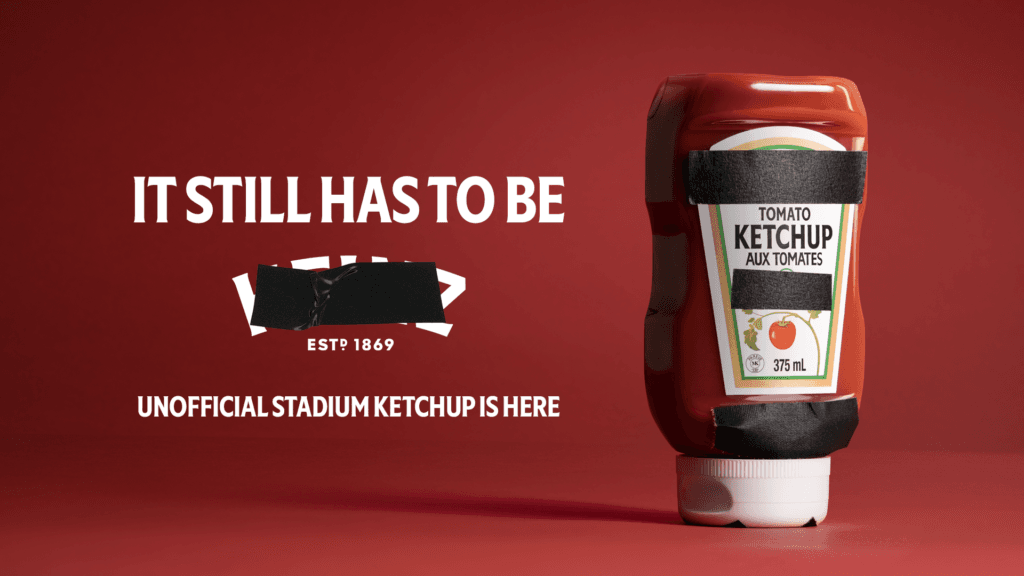
FIFA’s stadium rules for the World Cup have become a canvas for brands to generate PR. From Levi’s changing their logo to match the covered version on stadium, to Gillette and others following suit – the removal of non-sponsor brands inside the stadium has become an opportunity to make noise outside of it. In Canada, Heinz was inspired by bottles being taped over in venues to create a censored version of ‘unofficial stadium ketchup’, distributing modified packets to fans on their way into the game. The PR move continues Heinz’s commitment to being everywhere they’re needed, from ketchup hating Chicago hotdog restaurants to stadiums – and continues Levi’s trend of leveraging brand assets and expectations to be where you shouldn’t.
5.) ‘Poo Glorious Poo’ – Lyka:
No one will understand the conversations dog owners have had about their dog’s deposits unless you’ve been one. Pet food brand Lyka taps into the unique excitement of a ‘good poo’ with a musical number adapting Oliver’s ‘Food Glorious Food’, with a celebratory tune about what a good diet can enable for pets and owners. The brand’s claim ‘Glorious Food for Glorious Poo’ captures a super relevant sentiment while taking the messaging away from guilt and responsibility into celebration.
// Sunday Snippets
// Marketing & Advertising //
– How EV manufacturers shrank their product to compete [Auto]
– Former shoe brand ‘Allbirds’ has continued its pivot to AI with a new name, ‘Smartbirds’ [AI]
– Ferrari releases 8 hours of ASMR style content, with Lewis Hamilton taking a relaxing view of Monaco [Sports]
– ABBA meets Meatballs in an IKEA Manchester piece of content [Retail]
– Robert Irwin wants blokes everywhere to change their sheets more often [Home]
– Spark NZ uses the visual language of online gaming advertising to talk about scam protection [Technology]
– Heineken comes to the rescue after Scotland’s “Tartan Army’ drinks Boston dry during the World Cup [Drinks]
– Sam’s Club has rebranded to attract Gen Z, just look at their….apostrophe? [Branding]
– Zlatan can do anything, even sell Oakley sunglasses [Tech]
– HBO’s ‘House of the Dragon’ hypes its return with a Knicks themed throne at MSG [TV]
// Technology & Media //
– Hollywood is having its best box office since the pandemic [Cinema]
– Most Australians under 25 have never used newspapers or radio as a source of news [Media]
– What shape does the ‘enshitificaiton of content’ have? [AI]
– State Farm’s AI plan for sales agents hasn’t gone down well [AI]
– Adobe announces new AI assistant in Photoshop and Premiere [AI]
– Texas sets its sights on London’s AI and Technology market [Finance]
// Life & Culture //
– Is Henry vs. Lalas the most compelling battle of this year’s World Cup? [Sports]
– Sober curious consumption and the modern caffeine boom [Food]
– ‘Tarps Off’ has made more baseball stands a shirtless zone [Sports]
– Have wellness influencers stumbled on to a genuine issue when it comes to male fertility? [Health]
– Restaurant matchbooks are having a renaissance thanks to younger diners [Food]
– With World Cup visiting fans discovering new ranch addictions, Kraft releases TSA compliant packs [Food]
– Healthcare affordability has hit a new low in the US, with 49% of Americans reporting they can consistently afford it [Health]
// Related Issues
– Spotify’s “Real Fans” Bet vs. Google’s Forced AI Remixes
– Will We Pay for Our Social Media Memories?
– Social Media’s Slip Away From Socialising
– Airgo Trend Report: June 19, 2026
// Until Next Sunday
As always, let me know what you think by email (dubose@newclassic.agency), website or on LinkedIn.
You can also listen to an audio summary and discussion of each week’s newsletter on Spotify. We’re also on TikTok!