
In this issue of Sunday Strategy, we look at seven stories to think about next week, including:
– Ageism, Advertising & the Myth of ‘Silver Influence’
– The Risk of the Ad-Like Object
– Girls Who Play Sport Become Women Who Lead
– Kohl’s Didn’t Replace Its CMO
– One in Ten of Your Respondents Have Been to Space
– The Crying Face Wins
– AI Search Isn’t Killing Traffic, It’s Reshaping It
In addition, we have ads from Vodafone, Volvo, HDFC Bank, IKEA and Optus.
// Stories of the Week:
1.) Ageism, Advertising & the Myth of ‘Silver Influence’
Age is something advertising understands but doesn’t act on – and ‘silver influencers’ aren’t poised to fix it. By 2050 one in four people in North America and Europe will be over 65, and American seniors will outnumber under-18s within a decade. A Boston Consulting Group study across 12 markets, attributes the 870m people, aged 50 to 70, to roughly $7 trillion of annual spending, and seniors’ share of US consumer spending has grown from 14% in 2005 to 22% in 2022. Older consumers are more loyal as 18 to 39 year olds repurchase a brand 40% of the time vs. 60 to 74 year olds at 65% and over-75s at 70%. Internationalist Intelligence shows 92% of marketers describe consumers over 50 as financially stable.
However, only 17% of companies have dedicated strategies for 50+ consumers and employment in the industry is even worse. IPA research from eight years ago showed over-50s were 6% of the advertising workforce against 22% in finance, 28% in medicine, 30% in science and 35% in law. The lack of older advertising employees hasn’t just left a gap in consideration, it affects how older consumers are portrayed. Research shows they were seven times more likely than younger people to be portrayed negatively in an ad. The numbers were published, the pieces were written, and the composition of the room did not change.
Against this backdrop, continuing coverage of older influencers (often called ‘silver influencers’ or ‘granfluencers’) in social media and advertising presents like progress, but are anything but on second glance. Stories of influencers like Werner Kalecinski, an 89 year old German TikTok sensation, may seem like inclusion, but they’re often just another media channel to engage younger consumers – as it was framed in recent research studies, vs. a step towards balancing out advertising’s fixation on youth. With marketers lying on their CVs about being over 40, despite the spending power found in that demographic, inclusion needs to come from more than influencers.
2.) The Risk of the ‘Ad-Like Object’
The biggest danger from AI generated advertising might not lie with who made it, but who approves it. New research took 20 video ads from major brands and tested them with 3k US consumers – half of which were the original human-made spots and half of which were made (from idea to completion) by AI. The AI spots used briefs reverse engineered from their human made counterparts, aiming to keep the brand, message and strategy constant beyond production.
The research found that consumers could not reliably tell which was which – with AI ads reasonably undetectable from human ones. However the AI versions still performed worse on short-term sales potential and on long-term brand equity. The AI versions, while ‘looking like ads’ in production quality and surface feel – lacked some of the finer cues found in the human ones. For example, a Chewy ad featuring a dog named junior features a transition, where the dog ages as a sweater is put on and removed from him – subtly highlighting the passage of time and alluding to the emotions felt around dogs aging. The AI version missed this in concepting and instead showed the aging dog in a more confusing and less compelling way.
These small points, lost in the AI work, tap into what good marketers already know – the difference between good and great is found in small elements that may be imperceptible in the final product. What you do with production quality is more important than just the quality itself. The risk of AI creative is that we approve it based on how it looks, instead of what it says and lose the smaller points that make the ad work in the process.
This story is part of a trend Airgo tracks: Synthetic Disappointment
3.) Girls Who Play Sport Become Women Who Lead
Parity and e.l.f. Beauty’s research of more than 9,500 women (aged 18-65) across the United States, Canada, Germany and the United Kingdom found that women who played sport regularly are nearly 50% more likely to hold a leadership role at work, than women who played little or none. Additionally, they are 37% more likely to aspire to senior leadership and nearly 25% more likely to have negotiated their salary. The research positions girls’ sport as long-term economic infrastructure rather than, as it is often viewed at the higher levels – a media property, CSR or audience reach play.
4.) Kohl’s Didn’t Replace Its CMO
On 25 August Kohl’s eliminated the chief marketing officer role outright, with Christie Raymond leaving on 9 September, and elevated Arianne Parisi, its chief digital officer since 2025, into a newly created chief customer officer role – which covers marketing, brand and creative, loyalty, personalisation, media and digital commerce.
The disappearance of the CMO isn’t new news. Around 31% of the Fortune 500 already operate without a traditional one. However, this move adds nuance to the ‘death of the CMO’ narrative. It isn’t that the CMO role isn’t useful, it’s that the label and responsibility may not be aligned with what modern marketing hopes to achieve. In the absence of proven value, organizations are shifting CMOs into more bespoke responsibilities that are often niche. As seen with Kohls, chief customer officer is a comparatively rare role as roughly 1.3% of marketing teams gained one last year, against nearly three times as many gaining a chief growth officer.
5.) One in Ten of Your Respondents Have Been to Space
It’s important to remember that at their heart, surveys are just people’s attitudes and opinions – and people aren’t always reliable. Recently, Pew fielded an online opt-in panel of 11,114 US adults and found that 10% claimed to have visited the International Space Station, 9% claimed to receive benefits from an agency that closed in 1920, and 6% used a social platform that does not exist. Against these would-be astronauts, standard survey defenses didn’t work. 84% of bogus respondents passed trap questions and 87% got through speed checks, while voter file matching actively made things worse, because it removes people who decline to share contact details rather than people who are lying.
Pew isn’t alone in highlighting the constant risks to be considered in research. NORC describes 2026 survey fraud as structural rather than incidental, on the basis that systems built for speed and scale were never built for identity verification. A single operator with commonly available AI tools can now produce hundreds of responses that are coherent, demographically consistent and behaviourally plausible.
Pew’s poll shouldn’t be a sign to disregard research, instead it should make correct methodologies and design even more important. In the face of survey fraud, AI and synthetic respondents – these figures may push marketers away from human research, where the opposite should be true. As Pew states, the research highlights the risk of predominantly opt-in polls vs. those using offline recruitment and random sampling.
While no method is perfect – stronger survey design, greater understanding of what research can and can’t do and a dedication to finding out what real people actually think – beyond their space travel experience is more important than ever.
6.) The Crying Face Wins
Culture is constantly changing and so are the symbols around it – even emojis. Google has published an anonymised sample of 665 million Gboard emojis, showing how use changes based on generation and over time. In 2025, the loudly crying face became the most used emoji in the world displacing both of the laughing faces that held the position for years.
The shift highlights how generations abandon overused symbols and move on to new, generationally unique emojis to communicate. Emoji use stabilises with age, which makes the drift one directional: the youngest users keep moving and everyone else keeps meaning what they always meant. While brands treat symbols like emojis as fixed concepts, who they’re speaking to needs to reflect the subtle nuances in how their audience has shifted.
This story is part of a trend Airgo tracks: Generational Lexicon Drift
7.) AI Search Isn’t Killing Traffic, It’s Reshaping It
The rollout of AI overviews has reshaped user behavior and web traffic. Ahrefs claims that web traffic to some websites has been cut by as much as 58% thanks to overviews. In a similar piece of work, Brainlabs pulled Google Analytics data across 54 clients from January 2025 to April 2026 and found organic sessions down 10.5%, from 140.1 million to 125.4 million, with 46 of the 54 declining.
However, falling traffic hasn’t reportedly led to adverse commercial effects. AI-driven key events (like making a purchase or signing up to a newsletter) rose 335% in the research time frame, and the key event rate from ChatGPT, Copilot, Gemini and Perplexity referrals ran 1.5 times higher than from organic search. Even as traffic to the website begins to slip, users who do come are primed and more likely to take a meaningful action. Search traffic that’s lost is more likely casual visitors.
This story is part of a trend Airgo tracks: Agent-Legible Branding
// Ads You Might Have Missed:
Vodafone x Borussia Dortmund – “The Unseen Goal”
If a goal happens and no one films it, how can it live on for future generations? The first goal in Bundesliga history was scored by Timo Konietzka in 1963 during the opening minute of Werder Bremen vs Borussia Dortmund. While it was in front of 35,000 people at the Weser Stadium, it wasn’t captured on film.
Using AI, Vodafone has rebuilt the moment from eyewitness accounts, archival match reports, weather data and Dortmund’s under-19 squad physically re-enacting the movement to generate motion data, with BVB’s chief historian, the scorer’s brother and the chairman of the club’s largest fan club among those interviewed.
The activity shows the value of Generative AI to fill in the gaps, if it can be rooted in authentic inputs. Generative AI is traditionally being talked about to make content faster and cheaper but, Vodafone shows how it can be used to bring valuable moments back into existence.
Volvo – “A History of Safety”
Volvo’s dedication to safety has historical roots in more than what it’s invented, but also in what it has shared. The auto brand has famously given away innovations like the three point belt, making the patent free to every competitor. This belief to share or inspire greater automotive safety has guided the brand while also creating an unlikely car ad.
Their new commercial doesn’t feature any Volvos, instead highlighting Volvo invented safety features on competitor cars, pixelated for copyright reasons. The message is more powerful than any unique safety feature could claim on its own – as the ubiquity of Volvo’s safety technology shows its expertise and its commitment in a way others can’t copy.
HDFC Bank – “Vigil Aunty Says: Laziness Saves”
Fraud education is usually a public service announcement that people scroll past, so HDFC made a seven-episode stand-up comedy special for JioHotstar, India’s largest premium streaming platform, championing laziness instead. Each comedian’s set is built around a different form of everyday laziness, centered on the idea that urgency is what drives fraudulent schemes to succeed. Removing the pressure to act quickly, makes things like digital arrest scams or fraudulent links easier to spot.
The same idea has quietly been built into a product in the UK. Monzo’s Undo Payments puts a countdown on a completed bank transfer, fifteen seconds by default and adjustable up to sixty – cancelling it if you change your mind. The bank’s own framing is that it covers both mistakes and scams by giving people a moment to reconsider.
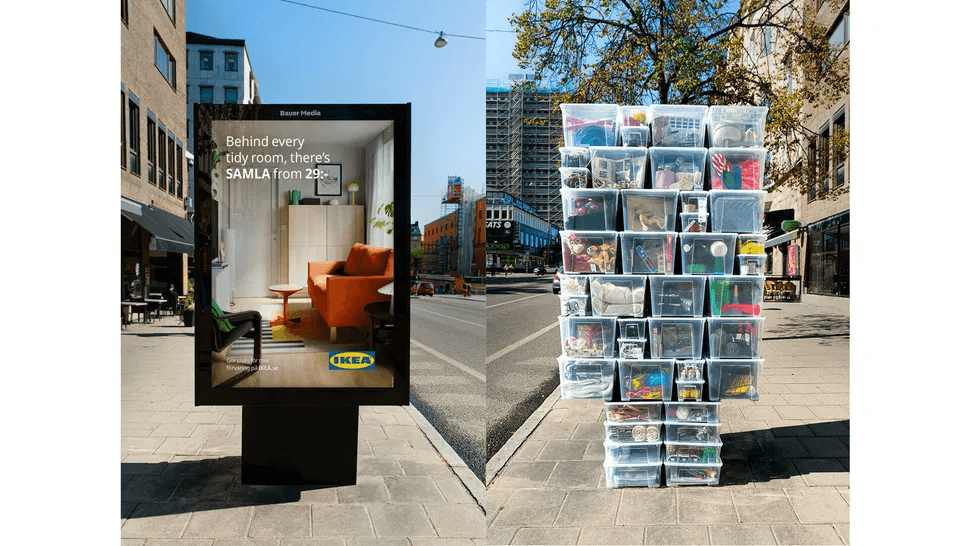
IKEA Sweden – “The Other Side”
Home furnishing ads normally assume a much more orderly room than consumers actually have. However, IKEA Sweden has acknowledged the truth of how many of us live – with a double sided billboard that shows a clean room on one side and real storage boxes crammed with toys, clothes, records and half-finished children’s drawings on the other.
While the cleaner room is aspirational, the category runs the risk of selling a home no one actually lives in. With IKEA’s unique take, we can see how realism and organization can come together.
Optus – “There’s Always a Way”
Australian telecoms brand Optus celebrates the country’s ‘knack of always finding a way’ in their latest ad – featuring product demos married with a five foot one grandma volunteering as a basketball coach. The national flattery finds her researching basketball and bringing the team together – making a ridiculous but compelling story a tool to stand out in a category normally known for generic connection messaging.
// Sunday Snippets
// Advertising & Marketing //
– Leroy Merlin invites buyers of 4,000 eligible products into a WhatsApp bot where the products themselves start messaging you, the paintbrush as a tortured artist and the wall plugs as a commando unit, until the job is finished. [Culture]
– Comic Relief US founded an organisation for people who would like to keep doing nothing about child poverty, which raises awareness for the one that does something. [Charity]
– Bud Light turned a brand act into an actual purchasable product with Can-O-Flage, built for fans watching their team away from home. [Food & Drink]
– Burger King Ecuador issued an official call-out to serving colonels in the country’s armed forces and ran them through a blind taste test to certify its new chicken. [Food & Drink]
– GWM converted disused petrol stations and created a ‘Funnest Runner’ trophy with City2Surf in a campaign about outrunning the fun police. [Advertising]
– The UPS Store introduced its first brand character, aimed less at customers than at its independently franchised operators [Advertising]
// Media & Technology //
– The FTC and 22 state attorneys general allege Amazon inserted a phantom bidder into its search auctions from 2019, described internally as a ‘soft reserve price’, reaching roughly 80% of auctions by 2024. [Media]
– Microdrama app downloads grew 95.5% year on year to 1.45 billion in the first half, with Southeast Asia at 518 million and Latin America at 355 million while Europe, the Americas and the Middle East together accounted for 17%. [Media]
– An MIT paper on the accumulation of ‘cognitive debt’ when using an AI assistant for essay writing has spread well beyond academia, though its authors caution against the sharper readings circulating with it. [Tech]
– IKEA furniture arrives in Skyrim as a Creation on 9 September, including a KALLAX shelf, to a reception best described as unimpressed. [Gaming]
– Netflix brings back Charlie and the Chocolate Factory as a ‘Beast Games’ style reality contest. No word if Augustus Gloop has recovered enough to participate [TV]
// Lifestyle & Culture //
– The UN General Assembly adopted the Correct the Map resolution on 4 September, 164 votes to one with six abstentions, asking governments, schools and technology companies to use the Equal Earth projection where relative scale matters. [Culture]
– Gallup finds 81% of Americans view free enterprise favourably against 54% for capitalism, with socialism at 39% and small business at 95%. [Culture]
– Of Glassdoor reviews from claims adjusters mentioning AI between June 2025 and May 2026, 98% were negative, making them the most AI-critical occupation in the American workforce. [Tech]
– Wavelength by MAX surveyed more than 14,000 US consumers and found Gen Z spends less than millennials in every beauty category measured, with 84% qualifying as affordable personal care shoppers, the highest share of any generation. [Consumer Behavior]
– Gen Z is reading more and returning to print. [Culture]
– Target has brought back Delia’s, the 90s teen brand that folded in 2014, as an exclusive collection priced from $8 with the catalogue reprinted for roughly 1,200 stores. [Retail]
– Bank of America card data has Gen Z restaurant spending up 7% year on year, nearly double millennials, with bar spend up 9 to 12% over the preceding three months. [Consumer Behavior]
// Until Next Sunday
As always, let me know what you think by email (dubose@newclassic.agency), website or on LinkedIn. You can also listen to an audio summary and discussion of each week’s newsletter on Spotify. We’re also on TikTok!