In this issue of Sunday Strategy, we look at eight stories to think about next week, including:
– Reddit Is Closing Its Doors One at a Time
– When the Government Writes Your Shopping List
– Do Shoppers Believe the Early Black Friday Deals?
– GTA VI Doesn’t Need Your Brands
– The Six-Minute Christmas Ad
– Demarketing Has Its Big Marketing Moment
– Take the Cars Out and Oxford Street Sells More
– Rent an AI Celebrity
In addition, we have ads from Apple, Home Instead, Quince, Rao’s, Oxfam, Tourism Tasmania, Etsy, Greenpeace, Aer Lingus, Shopify and Coterie, plus our Christmas ads tracker.
// Stories of the Week:
1.) Reddit Is Closing Its Doors One at a Time
How open will the internet’s favourite forum stay?
Reddit may have claimed it’s the ‘front page of the internet’, but it has spent the last few years closing inwardly. In 2024, it licensed its archive for AI use, in two deals, one of which was reportedly worth about $60 million a year. In September, it announced the next round, as its RSS feeds were due to stop in Nov, because RSS “is now a common surface for large-scale scraping and automated abuse”. By Saturday morning the main feeds were still running, but Old Reddit’s were redirecting readers to a login page. New requests for its public API stopped on October 31st, unregistered apps lose access on 12 Jan, and the public API closes by March 2027.
Amongst all of this, CEO Steve Huffman clarified that Reddit plans to become “a primarily logged-in experience”, because most unauthorised access “happens through our logged-out experiences”.
Though it’s closing to external requests, Reddit is simultaneously starting to sell itself in new ways. On November 10th, it said it is “starting to test” Reddit Reviews, where AI gathers what users say about a product across its communities into one page, with a summary and links back to the threads. It begins with about 10,000 products in the US, its buy buttons earn Reddit no cut, and brands can’t, for now, pay to be featured. Reddit’s pitch is that “half of U.S. shoppers say they come to Reddit to validate AI recommendations”, so a formalized experience is a clear next step.
Reddit’s gates coming down shows the tension between access and data that’s emerging across the web. Reddit built its value on being the open place people went to hear from other people. It now looks to be adjusting that openness into something it controls and sells, first as licensed data and now as a verdict on products. For brands that have relied on Reddit threads turning up in search results and AI answers, that access increasingly runs on Reddit’s terms. Similar to the age-old challenge of newspapers attempting to balance access and revenue, can the internet’s ‘Frontpage’ find a way to monetize but maintain what makes it great? Reddit may serve as one of the bigger test cases on how community and data can coexist in an age of AI.
This story is part of a trend Airgo tracks: Proprietary Episteme
2.) When the Government Writes Your Shopping List
What happens when the government hands out a shopping list?
In October, the UK Cabinet Office’s ‘Be Ready’ campaign asked British households to prepare for three days without power, water or phones. In the ten days that followed, hand sanitiser sales rose 83% year on year, bottled water 67% and tinned / jarred food by 37%, according to Worldpanel by Numerator. It wasn’t exactly panic buying, but pre-panic buying. The number of people buying tinned meat each day rose 43%, about 400,000 extra shoppers a day, but the typical purchase stayed at about 500g. “Growth came from more people adding the recommended items on the government’s checklist to their weekly shop,” says Worldpanel’s Fraser McKevitt.
Japan saw the same thing in the same fortnight. After its disaster minister signalled a request to stockpile water, food and portable toilets on 26 Oct, home-centre chain Cainz says it sold about 28 times as many portable toilets as a year earlier that week, 10x the emergency food and 9x the water tanks.
The least ready are the young. Barclays found 31% of 18 to 34-year-olds have three days of food and water at home, against 53% of over-55s, and only 6% of 18 to 24s told YouGov it would be very easy to find the room. The cost of living crisis seemingly extends to living through the apocalypse.
More generally though, when preparedness seems to be becoming a grocery occasion, with a government checklist behind it, how do other brands get on the list for a preparedness bump?
This story is part of a trend Airgo tracks: Ambient Precarity Normalization
3.) Do Shoppers Believe the Early Black Friday Deals?
“For many brands and retailers, Black Friday now lasts all of November,” as the Independent put it last week. Currys ‘Black Friday’ opened on Oct 28, a day or two earlier than in 2025, and Amazon’s Black Friday Week is the same twelve days as last year.
However, shoppers haven’t spread out with it. In the US, 64% expect to do most of their buying over Thanksgiving weekend, NRF says, up from 51% five years ago. Bain expects the days from Black Friday to Cyber Monday to grow 8.75%, nearly twice the season’s 4.5%. In Canada, 43% hold off on purchases all year to wait for the big sale days, up from 39% last year.
The disconnect between retailer and consumer buying behavior may come down to doubt. 18% of British Black Friday shoppers mention doubt about the early deals’ value, and only 54% across BCG’s ten countries trust that Black Friday prices are genuinely lower.
In the face of this, some retailers are selling certainty. Currys’ price guarantee refunds the difference if a qualifying deal drops again before December, and Argos will give a voucher if a badged price falls before Christmas. A refund if the price falls further is what 78% of UK sale shoppers told YouGov would get them to buy early. However, if an early deal needs a promise that it won’t get cheaper, is the sale strategy really holding up?
This story is part of a trend Airgo tracks: Verified Distrust
4.) GTA VI Doesn’t Need Your Brands
Grand Theft Auto VI comes out on Thursday with no paid placement in it.
Amongst news that 12.13 million pre-orders are estimated by Sensor Tower, worth $1.18 billion, the game stands apart from other marketing.
Take-Two’s boss Strauss Zelnick told Variety in the spring that “we’re not even at risk of doing brand partnerships because all the brands are made up. And I think that keeps us pure.” Even some of Rockstar’s Miami billboards have advertised their own parody brands.
Rockstar lets others talk about its world, but never puts their logos into it. YouTube is putting a GTA logo on its homepage for a 24-hour launch stream on 19 Nov, and says GTA videos have passed 900 billion views. PlayStation co-presents Rockstar’s Miami festival on Nov 21st, and the real club E11EVEN has become the game’s NINE1NINE. Selfridges is selling a real Grotti Cheetah, the game’s made-up supercar, built for Rockstar by West Coast Customs, for £1 million.
Brands that want in are left working around the edges. The prediction market Kalshi is paying a ‘GTA 6 Researcher’ up to $120,000 to play and report on the game’s economy, and the streaming platform Kick is giving 10,000 copies to viewers. Palworld’s maker Pocketpair has given staff who want to play “an urgent five-day business trip in Vice City”.
It appears that when the year’s biggest launch has no room for your brand, the nearest a brand may get is giving its staff the day off to experience it themselves.
This story is part of a trend Airgo tracks: Cultural Curation as Distribution
5.) The Six-Minute Christmas Ad
The Christmas ad seems to have outgrown the ad break.
Waitrose’s ‘The Perfect Gift 2’ runs 5 minutes 50 seconds, two minutes longer than last year’s, and Waitrose says it’s the longest advert a UK supermarket has made. The full film lives on YouTube and Waitrose.com, with 60 and 30-second trailers, cinema ads and romcom posters pointing to it like a film release. It passed a million views within three days, and on Friday Waitrose added a 1 minute 20 ‘Unseen Clip’, like a DVD extra.
The push for cinematic holiday ads isn’t limited to Waitrose. Apple’s ‘The Dreamer’ runs 3 minutes 53 seconds, Disney’s ‘The Invisible Horse’ 3 minutes 22 and Spain’s Lotería de Navidad film 5 minutes.
So are we overestimating how much attention the holidays can give brands? The first test results suggest length cuts both ways for Waitrose. System1’s panel put the six-minute cut 12th of its top 12 for long-term brand-building, on 5.6 stars, but fourth for short-term sales.
A long film is traditionally supposed to build the brand and leave the selling to the short ads. System1’s first read has Waitrose doing the opposite, leaving open questions about where attention can be found and kept during the holiday ad blitz.
6.) Demarketing Has Its Big Marketing Moment
What do you call an ad that asks you to use the product less?
Philip Kotler and Sidney Levy named it in 1971, in ‘Demarketing, Yes, Demarketing’ for HBR, but Skift has a newer word: the ‘anti-ad’.
This Christmas it’s everywhere. Xfinity has John C. Reilly show families what they miss on their phones, selling a button that pauses the WiFi, which its creative chief admits is “counter intuitive coming from a connectivity company”. Oxfam’s ‘The List’ has a south London estate mend and buy second-hand for a boy’s Christmas list, and ShelterBox has Richard E Grant unwrap a skimpy red thong to sell ‘a gift that means something’.
So is the latest push of ‘de-marketing’ working? Using it as a foil, ‘Visit Oslo’s’ 2024 film drew more than 25 million views, then a 17% rise in flight searches and a 14% increase in bookings, according to Visit Oslo, citing ForwardKeys and the airline Norwegian. Following suit, Tourism Tasmania now calls the island ‘Not Really For Tourists’. In travel, the natural tension of reassurance and exclusivity lends itself to the tactic.
In products, the balance is more difficult to find. The best-known case is still Patagonia’s ‘Don’t Buy This Jacket’ full-page New York Times ad on Black Friday 2011. Alongside this, 2015’s ‘Opt Outside’ by REI worked to ‘de-market’ under the same values driven message. Outside of these values though, can an ad like Xfinity’s square the brand’s normal cognitive dissonance or is it a holiday tactic that’s nice to say in December but irrelevant by May?
This story is part of a trend Airgo tracks: Real-Life Antidote
7.) Take the Cars Out and Oxford Street Sells More
Retailers have long believed that cars and parking mean sales, however London now has a week of payments data that says otherwise.
Almost a kilometre of Oxford Street went traffic-free in October, and in the first week spending at the stores tracked rose 28% YoY, from about £2.9 million to £3.7 million, per the Mayor of London’s office and payments data. In-store transactions were up 19% on the week before the traffic ban, while on Regent Street (which kept its traffic) they rose 1%. Footfall on the stretch was up 16% on last October’s half-term.
While it’s only one week, in half-term and during a varied holiday season, the figures are an initial counter to claims that the move would harm businesses. If it can hold, pedestrianization may become a greater tool to fight the long term decline of the high street.
This story is part of a trend Airgo tracks: Financial District Second Life
8.) Rent an AI Celebrity
What is a celebrity’s face worth once it can be bought on demand?
Recently, one of the world’s biggest ad agency networks and one of Hollywood’s biggest talent agencies said brands will be able to run campaigns with “entirely AI-generated celebrity appearances” of the talent agency’s clients, built from scans on a 204-camera rig (Digiday). Terry Crews has opted in. The pitch is volume: one shoot becomes 30 to 50 finished assets instead of 8 to 10, each labelled “[Talent Name] Approved | Recreated with AI” (Marketing Dive).
Crews says the fakes are here already: “There’s not a day that goes by where I am not tagged on at least 10 different A.I. versions of me doing all the things,” he told the New York Times. The EU’s AI labelling duty has applied since August, and its official guidance, formally published this week, uses this very case: a company that makes “a deep fake of a celebrity for an advertisement displayed in the Union” has to label it, even from outside the EU. In a sense of ‘if you can’t beat them, join them’, some celebrities are choosing to syndicate their likeness. However, consumer reaction to greater celebrity availability is unclear. If the label says the star approved it, will anyone mind that the star never said the line?
This story is part of a trend Airgo tracks: Creator Siege
// Ads You Might Have Missed:
Apple – “The Dreamer”
A boy who loves to draw gets knocked back and keeps drawing in private. In his teens his parents give him a MacBook Neo and show him they saw the artist all along, set to Strawberry Guy’s ‘Give Me a Dream’. Apple’s own description calls it “a parents’ gift that helps their son rediscover his creativity”. As the brand pushes greater accessibility to products with entry level pricing, it’s expanding the story of who creativity is for.
Alongside the message, the production mirrors Apple’s take on creativity. Every drawing on screen was made by the artist Hebru Brantley, mixing analogue techniques with work on the MacBook Neo. In a season when Christmas ads keep reaching for the handmade, a computer company is selling its laptop with art made by hand.
Home Instead – “Save Jeanie”
Jennifer Grey plays Jeanie Bueller again, 40 years after Ferris Bueller’s Day Off. With Ferris conspicuously absent, it’s Jeanie who does the shopping and picks up prescriptions for their parents. Along the way she revisits places from the 1986 film and meets Charlie Sheen’s character in a bar (a role he’s strangely aged into). He asks “Who says it has to be you?” and suggests Home Instead as a solution for caring for parents. The Omaha home-care company uses nostalgia as its way into a conversation about caring for parents, for an audience frequently aging into this challenge.
Quince – “The Red Sweater”
David Schwimmer chases a red jumper through New York and finds everyone wearing one, the dog included, a nod to the Friends storyline where a red sweater tells Ross he’s the father. It’s Quince’s first celebrity-fronted ad and the biggest campaign in its seven years, built around its $50 cashmere sweater, with niche Friends plots meeting 90s nostalgia.
This ad is part of a trend Airgo tracks: Nostalgic Spectacle
Rao’s Homemade – “Limited Time Only”
Rao’s has put a number on family dinner. Three people are handed a jar of its sauce printed with roughly how many meals they have left with a family member, then surprised with dinner together (Marketing Dive). The potentially macabre but powerful message borrows against a timeless tension, surfaced memorably by this website in the early 2010s, that we often take time for granted. We know deep down we should acknowledge the risk this could be the last time we’re together, but doing so puts the moment at risk. Rao’s tries to thread the needle for a difficult emotional challenge.
Oxfam GB – “The List”
Nine-year-old Neel lets his Christmas list float away on a balloon, and his neighbours make up everything on it between them, without buying new. When the presents arrive, he gives them to a young mum next door. The film points to Oxfam’s alternative Christmas list, a charity’s case for buying less, and buying better. Amongst a traditional charity model of forgiving consumption with giving and tax-deductible donations, Oxfam’s message of durability is an interesting holiday twist.
This ad is part of a trend Airgo tracks: Durability as Rebellion
Tourism Tasmania – “Not Really For Tourists”
A tourist joins an endless queue for a viral pastry, a line that stretches across the ocean, ends up in Tasmania and steps out of it. The campaign’s own research says 75% of Australians would rather be called a ‘traveller’ than a ‘tourist’, giving the tourism board an opportunity to draw a line on who the destination is for, something Tasmania calls ‘de-touristing’.
Etsy – “Make Them Last”
Etsy’s second Christmas spot is set to Olivia Rodrigo’s first holiday song, ‘take me home (4 christmas)’, and shows sellers turning personal memories into keepsakes. On Etsy’s channel it runs under the line ‘This year, don’t just make memories. Make them last’. It extends Etsy’s message of handmade over store bought to the holiday season and through using a music association, attempts to premiumize the brand against a tide of AI content and sales.
This ad is part of a trend Airgo tracks: Ritualized Seasonal Belonging

Greenpeace UK – “Attenboulder”
Greenpeace UK carved Sir David Attenborough’s likeness into a limestone boulder, showed it off on the Thames aboard its ship Arctic Sunrise and on November 12th lowered it into the Southern North Sea marine protected area. Greenpeace says it is the tenth boulder in a barrier meant to stop bottom trawling, in an area set up to protect harbour porpoises that it calls the UK’s most bottom-trawled ‘Marine Protected Area’.
According to Greenpeace, the Marine Management Organisation had written threatening legal action if more boulders went down, and Greenpeace says its officers radioed the same warning from a patrol boat as this one went in. The MMO had not commented, but there’s no denying you wouldn’t want to cross David Attenborough or the Attenboulder.
Aer Lingus – “The Irish Airline”
Aer Lingus’s own survey asked Americans what it was, and 66% didn’t know, with guesses that included “a pasta brand, a wrestling move and a type of dog” (Famous Campaigns). In the face of this confusion its new ads, co-written by and starring Sharon Horgan, simply call it ‘The Irish Airline’.
While the name is an anglicized, phonetic spelling of the Irish words ‘aer loingeas’, which translates literally to “air fleet”, the ads don’t worry about oversimplifying cultural heritage. Its YouTube description admits: “We probably should’ve just called ourselves The Irish Airline. But we didn’t.” A national carrier normally has the tendency to push its own culture into another market, but in the face of US confusion, Aer Lingus has chosen oversimplification.
This ad is part of a trend Airgo tracks: Place-Based Identity Assertion
Shopify – “Just an Idea”
Shopify’s new two-minute brand film follows four sets of first-time founders as everyday ideas become businesses, with Sidekick, its built-in AI assistant, doing much of the work, claiming “You’ve got an idea. Now’s the time to do something about it.” Its head of creative Neal Hicks says “a film about technology doesn’t make anyone believe in themselves”, so it was shot on film and keeps the AI in the background. Technology becomes a supporter, not the focus.
If that sounds familiar, it’s GoDaddy’s pitch, redone. GoDaddy’s 2025 Super Bowl ad, ‘Act Like You Know’, sold the same promise, that you bring the idea and the platform’s AI does the hard part, as a comedy with Walton Goggins pretending he knows what he’s doing. Shopify’s version has four unknown founders, filmed documentary-style, with the AI out of the spotlight.
Will the same approach, nearly two years apart, land in a similar way?
This ad is part of a trend Airgo tracks: Accessible Automation
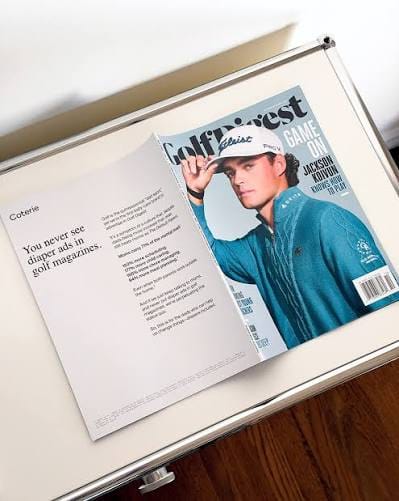
Coterie – “Golf Digest Back Cover”
You don’t normally see a diaper ad in a golf magazine. Last month Coterie bought the back cover of Golf Digest for a text-only page that opens “You never see diaper ads in golf magazines” and ends “This is for the dads who can help us change things, diapers included”, with six-time PGA Tour winner Max Homa.
Coterie says it is the first baby-care brand ever to advertise in Golf Digest, whose readership is more than 75% male, while about 90% of its own subscribers are women.
// Christmas Ads Tracker //
Every other Christmas ad since last week that launched with a film on the brand’s own channel, newest first. For our full list, check out the Sunday Strategy Holiday Ad Tracker.
13 Nov: Transport for Wales, Good Impression; Hallmark UK, Christmas film; Southampton FC, The More the Merrier; Hobby Lobby, Give Beautifully With Hobby Lobby.
12 Nov: A Place for Mom, Our Family’s Holiday Tradition; Litter-Robot, The Dog House(s); Discover Puerto Rico x Rita Moreno, Parranda Mode: ON; Crisis UK, Crisis at Christmas.
10 Nov: Suchard, Capítulo 2. Turrón; Brunello Cucinelli, Holiday Season 2026; Albert Heijn, Kom alvast in de kerststemming met Iris!.
9 Nov: Lidl Schweiz, Weihnachten bei Lidl lohnt sich; Lidl Polska, Odkryj świąteczną radość z Lidlem.
8 Nov: Morrisons, Christmas Made Just Right.
More From Last Week:
Lidl Germany, Christmas film; Liverpool FC, To the world’s greatest fans, nice one; Shinsegae, Send Your Holiday Wishes; PayPal, Your Season to Shine; Aldi Ireland, Kevin The Carrot And The Christmas Wish; Coca-Cola Brazil, Christmas film; Maisons du Monde, Christmas film; Pepsi Canada, A Pepsi Holiday; FIGS, Never Change; Etsy, There’s a workshop for every wish; Amazon.pl, Dziel się radością; Continente, Popota 2026.
// Sunday Snippets
// Advertising & Branding //
– Coca-Cola’s AI-made ‘Holidays Are Coming’ trucks are back for a third Christmas, and its European CMO says “We believe in consistency”. System1’s panel gives the ad 5.7 stars. [Advertising]
– In Pepsi’s 15-second holiday ad, Santa gets pizza and Pepsi Zero Sugar instead of milk and cookies, and Santa appears to be a polar bear, Coca-Cola’s old Christmas mascot. [Advertising]
– Oreo’s first new holiday ad since 2021 has a dad sneak a bite of Santa’s cookies, so on Christmas morning his presents, golf clubs included, arrive with bite marks: ‘Get your own Oreo.’ [Advertising]
– Sky’s ‘biggest ever Christmas campaign’ is set in a costume emporium where outfits from Sky, Disney+, HBO Max, Netflix and Hayu come to life. [Advertising]
– In the Spanish Christmas lottery’s ‘Corazonada’, a heart-transplant patient follows a hunch to a lottery office and meets his donor’s sister, a meeting Spanish law would never allow officially because donor and recipient stay anonymous. Its line is ‘Compartir nos da la vida’, sharing gives us life. [Advertising]
– Calvin Klein has posted a 66-second holiday edit fronted by BTS’s Jung Kook, which had 583,052 views on its channel in about three and a half days. [Fashion]
– Sabrina Carpenter orders her signature Go Go Highball in a jazz bar in Johnnie Walker’s 60-second holiday film, directed by Damien Chazelle and styled on French New Wave cinema. Adweek says the partnership with her is meant “to reach the next generation of whisky drinkers”. [Advertising]
– Pamela Anderson’s beauty brand Sonsie has made its first holiday film, a stop-motion garden “created entirely by hand without AI” over eight months by at least 23 people, People reports. [Advertising]
– Edgar Wright turns a corner shop into a kung-fu fight for Apple Pay, where a man has to pay for the groceries before he can use them as weapons and survives a Face ID gag: “Right phone, wrong face”. [Advertising]
– Adobe’s ‘Made to Create’, its biggest brand campaign in five years, features more than 30 artists from 18 countries and premiered at Adobe MAX in Miami Beach, with a version airing in the NFL’s Thanksgiving Day broadcast. [Advertising]
– Maybelline has rewritten its 1991 tagline as ‘Maybe. We’re born with it. Maybe. It’s Maybelline.’, swapping ‘she’ for ‘we’ and launching it with a 45-second Miley Cyrus spot. [Branding]
– Axel Arigato’s Christmas campaign is a recurring teleshopping show, with hosts selling sneakers on Instagram and TikTok from a set styled on 1990s home-shopping TV. [Fashion]
– Shanghai regulators have fined the company running Dove chocolate’s official Kuaishou store 800,000 yuan over an ad in which a woman gets the man she’s flirting with to deliver a gift box while her boyfriend is away. Regulators ruled that it promoted the wrong values about love and marriage. [Advertising]
– Britain’s ad regulator has banned ‘carbon-neutral delivery’ ads from Who Gives A Crap, ProCook, Grind and SportsShoes.com, because none said the claim rested on buying carbon offsets. [Sustainability]
// Marketing & Media //
– YouTube will share its streaming data with Billboard again in 2027, after Billboard gave ad-supported streams more weight. Under the old formula, 1,000 paid streams counted the same as 2,500 free ones. [Media]
– Publishers are making more money from fewer readers in the third quarter: The Sun’s global monthly audience fell 26% in September and People Inc’s core sessions 26%, while the New York Times grew digital advertising 12% and People Inc’s licensing revenue rose 49%. [Media]
– Priceline is the first travel brand to put its AI agent, Penny, inside Snapchat ads, where users plan a trip in a chat that carries over to Priceline to book. Priceline says Penny users convert at about twice the rate. [AI]
– Japan’s LINE now has 10.9 million paying Premium members, who can unsend a message for up to seven days while free users get one hour, and its chief executive won’t rule out more free features going paid. [Social Media]
– The Onion is running a print sale to raise the roughly $400,000 it needs to sponsor a college bowl game on ESPN. [Media]
// AI & Tech //
– OpenAI has opened Businesses in ChatGPT, a beta where companies can claim a profile, add product feeds and see how often ChatGPT mentions them. [AI]
– The European Commission’s proposed Digital Fairness Act would make AI shopping agents disclose when they are paid to suggest a purchase and ask the customer to confirm it, and give people a switch to turn off features that “encourage continued use by simulating interpersonal relations”, such as a chatbot’s persistent prompts to keep talking. [Regulation]
– 86% of businesses think customers are happy with AI customer service, but only 51% of customers say they are, Twilio finds in a survey of 7,652 consumers in 18 markets. 78% have tried to get past an AI agent to a person. [AI]
– Google’s camera glasses, made with Warby Parker and Gentle Monster, went on preorder from $395 on 12 Nov, and they blur the faces of people nearby before Gemini sees the picture and won’t record if the camera light is covered. [Tech]
– Sony has brought back the headphones that came with the first Walkman in 1979, orange foam pads and all, now with a USB-C plug and nothing to charge, for $59.99 in the US and £49 in the UK. [Tech]
// Retail, Food & Drink //
– TikTok Shop has started offering a $9.99-a-month membership to the more than 1 million US shoppers it counts as its most loyal, with free shipping and an extra 10% off, priced under Amazon Prime’s $14.99. [Retail]
– SKIMS’ $148 advent calendar drew a backlash when unboxing videos showed twelve doors of scrunchies, hair ties, bobby pins and keychains. SKIMS has reportedly offered buyers a full refund, or store credit while keeping it. [Fashion]
– Vinted now has about 17.4 million UK users, roughly one in four people, and Dazed calls it Britain’s third-largest fashion retailer, ahead of Zara, H&M and ASOS, as some users describe the app as addictive. [Retail]
– Under $100, a women’s sweater is about twice as likely as a men’s to contain polyester (59% against 30%) across six US fashion chains, an analysis by Style Analytics finds. At H&M and American Eagle, men’s sweaters are five times as likely to be all natural fibre. [Fashion]
– After its North American comparable sales fell 8.3% last quarter, Papa Johns is giving a free pizza for an unedited photo of your order plus an honest review, and its chief executive says an AI will assess the photos. [Food & Drink]
– Greggs has opened a permanent suite at Newcastle’s five-star Hotel Gotham, from £335 a night, where a gold rotary phone orders a sausage roll on a silver platter. [Food & Drink]
– Half of Popeyes’ UK customers are aged 18 to 34, and its recommend score among them nearly doubled in a year despite ad awareness far below other chicken chains, YouGov finds. [Food & Drink]
– Outback Steakhouse in South Korea is serving a bone-in steak shaped like Thor’s hammer on an Avengers: Doomsday menu from 10 November, next to a dessert carrying Doctor Doom’s emblem, Dexerto reports. [Food & Drink]
– US spirits sales fell 2% in the four weeks to Halloween, but non-alcoholic spirits rose 22.7%, the fastest-growing segment, NielsenIQ finds. [Food & Drink]
– A third of South African township residents belong to a stokvel, a members’ savings club, and grocery stokvels pool money for December, when much of the 21.1% of retail sales that lands in November and December is spent, a Brand Journal report finds. [Finance]
– Researchers at UCSF have found a slow dopamine signal from the gut that teaches the brain to like foods after they are eaten, in animal studies that may explain how black coffee goes from bitter to a morning habit. [Food & Drink]
// Sport & Entertainment //
– Eurovision’s first Asian contest went to the Philippines, as 19-year-old Carmelle won in Bangkok with “Sobra-Sobra” on 211 points, ahead of hosts Thailand on 170, with public votes from 183 countries and territories. [Culture]
– After a boycott call and players tagging the FTC, Epic published the odds of finding the Fortnite token that unlocks its item shop free for two weeks: 1 in 137,500 chests. [Gaming]
– Netflix’s ‘Find The Thing You Never Knew You Needed’ films, shot on 35mm on built sets, have a vampire risk the sunrise to finish ‘Love Is Blind’ and an astronaut wake his crewmate to talk ‘KPop Demon Hunters’. [TV]
– RunPee, an app that tells moviegoers the best moments to go to the bathroom, had about 231,000 active users from March to October, as action films now average 128 minutes, 25 minutes longer than a few decades ago. [Media]
– Mattel’s doll billings rose 4% to $703m in the third quarter, “driven by KPop Demon Hunters”, the Netflix film, while “Barbie was a drag on the category”. Its chief marketing and brand officer is leaving for Netflix. [Retail]
// Life & Society //
– More than half of Americans put travel and live events top of their holiday wish lists, but only 15% are putting experiences first in their budgets, Visa finds. Higher-income households plan to spend more on the holidays (a net +18%) while lower-income ones plan to cut back in every category (a net -26%), Alvarez & Marsal finds. [Consumer Behavior]
– The share of Germans likely to buy a Chinese-made EV rose 13 points in a year, and 12 in Canada, in a 33-country GlobeScan and Chatham House survey, even as more people say they aren’t interested in EVs at all. [Automotive]
– Japan’s word-of-the-year shortlist includes ‘guilty’, as in guilty-pleasure buying, helped by Suntory’s ‘guilty soda’ NOPE, which Suntory says shipped 100 million bottles in 150 days, and a convenience-store bento with just one side dish. [Culture]
– PwC is putting more than 85,000 of its US people through a critical-thinking and judgment certificate, to be finished by June 2027, as AI pushes entry-level jobs toward judgment calls. [Work]
– The Wellness Society, a campus fitness club started at the University of Alabama in 2024, says it has over 75,000 members at more than 145 universities, and a co-founder says “we have 50 given brands that we know will send product for free”. Celsius and Alo have signed partnerships. [Health]
– California Cryobank charges $70,000 to keep a sperm donor for one family and $35,000 to share him with no more than nine others, as Bloomberg reports that paying to limit a donor’s number of families is spreading. [Health]
– Three in ten UK adults have gone without essential furniture they couldn’t afford, and more than one in five of them have slept on the floor, finds DFS, which funds beds and sofas for families through BBC Children in Need. [Charity]
– Clapham nightclub Infernos has ripped up its famous carpet and is giving five pieces of the dance floor to competition winners, to be drawn on Nov 16th. [Culture]
// Until Next Sunday
As always, let me know what you think by email (dubose@newclassic.agency), website or on LinkedIn. You can also listen to an audio summary and discussion of each week’s newsletter on Spotify. We’re also on TikTok!