As AI tools optimise our writing toward the shortest path, we may be quietly losing something valuable: the digression. This issue asks whether efficiency is flattening how we think and create, alongside the durability of small-business optimism, Bumble’s move away from the swipe, “Blue Dots” vs. mid-tier artists, and what “Politician Pokémon” reveals about vibe coding’s value.
In addition, we have ads from: Adidas, Planet Water Foundation, LEGO, Huggies and Anchor.
// Stories of the Week:
1.) Is This The Death of Digression?
Is there anywhere left for a longer message or has culture and technology optimised the way we speak towards brevity? AI optimised writing has already changed the words we choose and the detail we provide when communicating – with grammar checkers evolving to suggest new sentences and LLMs rewriting whole emails or messages. AI writing tends to optimise to shorter, more direct sentences, stripping out the digression and personal asides natural to human conversation. Heavy LLM users write essays with 50% fewer pronouns and are less likely to describe their writing as ‘their own voice’.
However, we can’t fully lay the blame for a newfound brevity at AI’s doorstep – it is the accelerator, not the creator of the trend. Culturally, brevity is having a moment. The book ‘Smart Brevity’ has sold over 350k copies – while claiming ‘brevity is confidence, length is fear’. More popularly, analysis of NYT bestsellers from 1931 to 2025 has found that average words per sentence have decreased by a third.
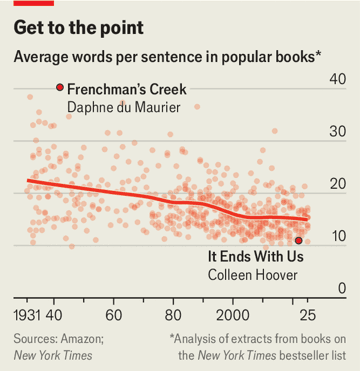
Popular writing has been getting to the point faster for decades, with the pace accelerating sharply since 2000. The share of 400+ page books on the list fell from 54% in 2011 to 38% in 2021, with shorter books averaging 7.8 weeks on the list vs. 5.9 for 400+ page books. Beyond AI, a decline in reading levels and greater digital overload may be to blame. Authors of all types are seemingly optimising to get a point across to a less engaged, ‘drowning in messages’ reader base – with our daily communication following suit. However, optimisation and detail, creativity or enjoyment are often opposing forces.
So is there any hope left for digression and indulgent writing? As AI pulls writing to the ‘LinkedIn Average’, opposing styles stand out further. Growth in channels like Substack shows that detailed analysis and digression can still sell – especially to an audience looking for it. Fantasy novels are still succeeding at longer lengths – with 2025’s Onyx Storm selling 2.7m copies on opening week while being over 500 pages. World building in fantasy books requires digression, as does a persuasive argument in Substack. As AI accelerates the shortening of our daily communication, digression may have temporarily retreated to where it has a natural home. Though as technology businesses talk about hiring ‘storytellers’ to cut through AI slop, the ability to digress and storytell may become a rare, but premium quality.
Read More Here.
2.) Can SMB Optimism Endure More Economic Chaos?
With the economy downright terrifying, can SMBs find some optimism or happiness? The most recent US NFIB Small Business Optimism Index recently fell 3 points to 95.8 – leaving it below its 52 year historical average of 98. With SMB uncertainty rising (4% to 92 and well above its historical average of 62), it’s easy to assume that businesses aren’t looking forward to the future. However, more are holding out hope than not, with 11% net positivity about conditions 6 months from now.
Additionally, Vistaprint’s new 2026 Small Business Happiness data reports that despite difficulties and worries, 84% of small business owners say they’re happy today (42% each say ‘very happy’ or ‘somewhat happy’). With 43% saying they’re happier this year than last year, tough economic conditions don’t seem to have affected SMB owners’ attitudes.
Vistaprint reports that freedom (54%), ‘doing something I love’ (47%) and ‘control over income’ (35%) are consistently ranked as top three reasons to like being a SMB – despite uncertainty (41%), ‘poor work life balance’ (40%) and ‘trying to keep up with evolving trends’ (38%) as top challenges. Balancing these issues has seen 74% of owners using AI monthly or more, with 57% saying its helped make them happier. Overall, SMBs are seemingly still bought into the chance to carve out a way to succeed, despite very real economic challenges.
3.) The Blue Dot Divide Between Megastar and Mid Tier Artists.
Coverage of cancelled tours and financial struggles within the touring industry have given rise to the term “Blue Dot Fever” – named for the empty seats on ticket websites. However, the ‘virus’ may not affect all artists in the same way, as stadium tours by artists like Beyonce, Oasis and Coldplay are still profitable. However, the tier of artists below stadium acts, like Post Malone, Kid Cudi and Jennifer Lopez have been more strongly affected by cancellations and financial difficulties. Pollstar 2025’s data showed that while stadium averages were up 19% per show in 2025, mid arenas were down 2.5% and clubs under 750 people were down 7%.
Artists large enough to provide ‘flagship experiences’ have benefitted from a market ‘consolidating upward’, while smaller venues and acts face greater cost scrutiny and changing entertainment tastes. As venues offer a wider array of added extras and additional charges to increase profitability, the value proposition for many concerts is under scrutiny. The challenge leaves mid-tier artists in an untenable position, unable to lower prices due to high logistical costs, while selling to consumers unwilling to pay the price. Cancellations in this environment say less about an artist’s waning popularity and more about a financial mismatch the mid-market doesn’t have an answer for.
4.) Can Bumble Move Beyond the Swipe?
With Bumble set to overhaul its offering in response to falling user numbers, how far can it go from its heritage? Can it abandon the mechanism at the heart of dating apps and…break up with the swipe? From Tinder to Bumble – swiping left or right on potential dates is an understood mass behaviour that lives beyond the sector in culture and conversation. Moving beyond it, as Bumble CEO Whitney Wolfe Herd has confirmed for Q4 of this year, takes the brand to unique and new, but risky territory.
While Herd hasn’t clarified what the new feature will be, it’s likely it will involve AI and matchmaking. With an assistant that already helps users match (called “Bee”) in testing, a technology powered solution seems likely. AI powered match-making has already been used in various forms across the category, but can a brand that helped popularize the swipe, swap to it? With the cost of dating increasing and users talking about IRL and more intentional romance, AI suggested matches will need to provide a sense of value beyond what swiping did. However, as a Boston University survey found only 10% of women and 20% of men agree that AI powered dating apps lead to more successful relationships – Bumble may be swiping on their current challenges to a set of new ones.
5.) Politician Pokémon and What AI Coding Can Do Well
Against the growing ‘AI slop’ discourse, it’s important to hold up the opposite, especially when it’s clear how AI helped unlikely, clever ideas become real. As the UK went to the polls last week for local elections, a new game launched to drive UK citizens to think about who their local politicians are. Inspired by Pokemon, developer Fred Parry used AI to create pixelized versions of every major UK politician, turning them into creatures you can capture and pit against each other. The goal, to make people think about who is potentially representing them and their positions – valuable to an electorate that is increasingly struggling to positively engage politically. Amongst the idea, GenAI plays a valuable role in scaling graphic design and takes a good idea, which could have died logistically, and makes it real.
// Ads You Might Have Missed:
1.) ‘Backyard Legends’ – Adidas:
Adidas’ latest ad combines Marty Supreme and the World Cup for a star studded story that involves Jude Bellingham, Lionel Messi, Bad Bunny, Trinity Rodman, Lamine Yamal and more. Shifting football from the stadium to the street court, Timothee Chalamet channels his ‘Marty Mauser’ role to take on a crew of three pickup footballers who reportedly haven’t lost since the last US World Cup. With subtle nods and cameos from Zinedine Zidane, David Beckham (who gamely agreed to whiff a shot as a plot point) and others – the ad is arguably the most hype filled World Cup ad since Nike’s Write the Future, while not talking directly about the tournament itself.
The journey from 2010’s Nike ad featuring a global stage to 2026’s Adidas ad centering on the neighborhood mirrors a shift in football culture from monolithic national identity to players and smaller groups. Though planning for this will have gone ahead well before the tournament’s current challenges and news cycles, the shift to informal street play and away from increasingly exclusionary games in venues sits well with how this World Cup may be discussed and played. With tickets and transport pricing many fans out of going live, viewing and playing soccer in neighborhoods, as the ad portrays, looks to be a much more likely reality.
2.) ‘Bottle It Back’ – Planet Water Foundation:
Carbon footprints have become a part of daily life when we talk about emissions, but what about the increasingly prominent issue of AI & water usage? One AI prompt consumes approximately 38ml of water to cool a data center. As data centers increasingly impact water access around the world, servicing increasing AI demand, the Planet Water Foundation has created a campaign to track usage of AI services in terms of your ‘AI Water Footprint’. As you prompt, it reminds you how much water you’ve affected, asking you to donate to ‘offset’ usage.
The campaign itself is genuinely insightful and creative, but it also touches on existing issues around ‘offsetting’ and ‘footprint’ behavior. As with carbon emissions, the ‘personal footprint’ narrative has been accused of shifting responsibility from organizations (like petrochemical in the emissions case) to end users – something that may see smaller potential returns. Additionally, carbon offsetting has often been accused of creating an indulgence system – where users ignore the impact of a behaviour because of the ability to offset it, often doing it more than they would otherwise. The great idea behind ‘Bottle It Back’ already faces a significant challenge in the form of AI & Water use, but additionally inherits the same problems of similar approaches in other sectors. While no one expects it to solve all of these singlehandedly, it may need to consider how to avoid the existing pitfalls that carbon and offsetting have uncovered before it.
3.) ‘Updated for You, Sir David’- Lego:
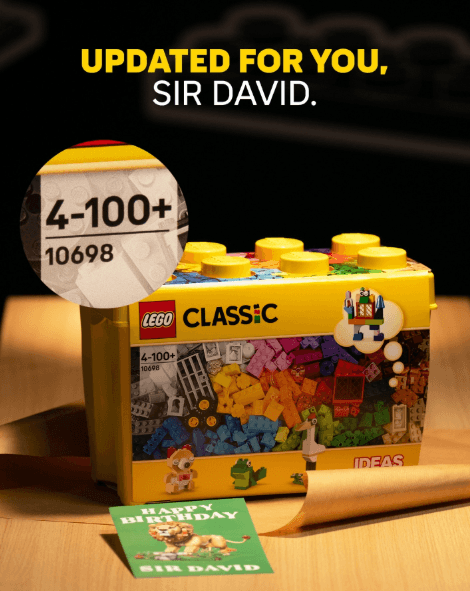
When you pay attention to what your brand already owns and what culture is already saying about it, the wins get easier. To mark Sir David Attenborough’s 100th birthday, LEGO posted an instagram image of its packaging with the recommended age bumped from 4-99 to 4-100+, captioned “There’s no age limit for those who never stop playing.” While it may seem like the move was prompted by Sir David alone, it actually builds on a conversation about another centenarian. As Dick Van Dyke turned 100 last December, the internet jokingly started a petition to change the LEGO age range now that he was ‘banned from it’. What started as a fan joke is now a recurring property in social media, thanks to a clear understanding of what people are saying and what the brand has at their disposal.
4.) ‘Let’s Get Absolutely Buttered’ – Anchor:
Creating a distinct butter ad is a hard challenge to churn. Ads usually choose between talking about the heritage of the product (talking cows and quality farms abound), quality (texture, smoothness) or the food the butter enhances (such as in Lurpak’s eponymous Kitchen Magic campaigns). Anchor’s new “Let’s Get Absolutely Buttered” admirably tries to blaze a new route. The 30-second hero spot opens on a woman so lost in a buttered crumpet that she doesn’t notice her narrowboat sinking behind her on the canal. Two kids on bikes deliver the verdict: “she’s been on the double churned. Absolutely buttered.”, while her partner yells in the lock. The line riffs on British slang for being properly drunk, repositions indulgence as a benign vice, and gives Anchor a brand phrase distinctive enough to live outside the ad – while eschewing more known territory.
5.) ‘Little Fighters’ – Huggies:
Huggies has taken a page out of Canada’s ‘SickKids Foundation’, with a campaign that repositions NICU babies as ‘little fighters’. The campaign highlights that some of the world’s smartest minds (Isaac Newton was reportedly born 3 months premature) and strongest athletes (Derrick Hall and Allison Schmitt) started life in the NICU. The message attempts to reframe NICU babies from fragile to strong, and in the process celebrates the moms, nurses and caregivers who support them.
Huggies has a clear product reality behind the campaign, in the form of micro and nano preemie diapers, as well as a social cause element, social shares of the campaign unlock a set donation amount to the Derick Hall One Percent Foundation. However, beyond the good it sets out to do, there is a wider question about why the brand has taken the approach it has. With strategic and creative similarities to ‘Sick Kids vs.’, it feels like a charity campaign – leaving an open question if commercial results through building preference to wider Moms was expected. Though this added dimension is unclear, the intent to create a positive impact, more than enough for many campaigns, is undeniable.
// Sunday Snippets
// Marketing & Advertising //
– McDonalds NZ bottles pickle juice to relieve football players’ cramps [Food]
– IKEA shoots a new campaign from inside its iconic Frakta bag [Retail]
– Canva’s new ads position it as the ‘thing that makes a thing’ [Software]
– Tequila brand Teremana brings people together with a foldable table in a billboard [Alcohol]
– Dunkin’ owner Inspire Brands confidentially filed for IPO [Food]
– Magnolia Bakery is coming to London for a month long pop-up [Food]
– Versus & Levis drop an England collection ahead of the World Cup [Fashion]
– Audible launches a ‘bookless bookstore’ in NYC [Events]
– Not to be outdone, Ray-Ban has opened a restaurant concept in Soho [Events]
– Gatorade expands its research and study initiatives to understanding more about women in sport [Fitness]
// Technology & Media //
– Google’s new $99 ‘Fitbit Air’ is less about the band, despite taking on Whoop, and more about the AI coach behind it [Fitness]
– OpenAI launches self serve ad manager for ChatGPT Ads [Media]
– Apple AirPods with cameras (for additional AI context) are reportedly in final testing [Tech]
– OpenAI introduces a “trusted contact” feature to alert in case of troubling behaviour [AI]
– Chick-fil-a is reportedly testing a 24 hour vending machine – no word if it is unplugged on Sundays [Food]
– More than half of younger consumers join and then leave streaming services for a single show [Media]
– AI brands continue to buy the channel they’re selling against [Media]
– FIFA to drop Panini for World Cup deal for Fanatics in 2031 [Media]
– Tech Billionaires want to frame AI as moral [AI]
– The Rise of Emotional Surveillance: How companies are monitoring for agreeability, not just productivity [Privacy]
– How YouTube took over the American classroom [Media]
– Disney signs ‘Toddler Techno’ DJ deal [Music]
// Life & Culture //
– 1.3m people applied for the 2027 London marathon, putting the focus back on a possible two day expansion [Sports]
– According to Gallup, reported rates of US depression remain historically high [Health]
– Can wearable patches disrupt the supplement industry? [Health]
– The analog revival that didn’t take place [Culture]
– Mahjong is rapidly becoming the ‘third space’ of the moment [Culture]
– The Era of the Beta Mom [Culture]
// Related Issues
– Branded Horror: When Brands Lean Into Halloween Scares
– Productivity Paranoia: Managing AI’s “Infinite Potential”
– Spotify’s “Real Fans” Bet vs. Google’s Forced AI Remixes
– How Gen Z Is Killing the Midlife Crisis
// Until Next Sunday
As always, let me know what you think by email (dubose@newclassic.agency), website or onLinkedIn. You can also listen to an audio summary and discussion of each week’s newsletter on Spotify. We’re also on TikTok!