Is AI-fuelled delusion becoming the new version of social media’s extremism problem? This issue weighs the two, plus LinkedIn’s lifestyle expansion, the rise of the “micro-trip,” budget premium airlines, and what’s behind Allbirds’ decline.
In addition, we have ads from: Triodos Bank, Griffins, Human Forest, Canada Soccer and Cheetos.
// Stories of the Week:
1.) Is LinkedIn For Everything Now?
Has LinkedIn expanded beyond its professional heritage into the rest of our lives or have the rest of our lives become more focused on the professional?
As DJ John Summit gave a surprise set in partnership with LinkedIn and Spotify this week, the network’s pop culture expansion was on full show. With everyone from musicians to Heisman winners active on the platform, it looks less like a job seeking tool and more like any other social platform. A 2023 migration of users from Twitter / X to platforms like LinkedIn, coupled with greater career pressure and a worse economy has expanded how the platform is thought about. In a 2024 Muck Rack survey, 61% of PR professionals said they planned to use LinkedIn more, versus just 15% for X. LinkedIn’s 2025 algorithm shifts have reportedly prioritized authentic, human content over corporate or polished messaging, taking it further from the corporate style of its heritage.
But as the brand becomes more about the lifestyle around work, can it avoid just becoming every other social network? Or is it that work is such a naturally large part of our lives and culture now, that the world came to LinkedIn vs. the other way around?
2.) Social Media Extremism vs. AI Delusion
Can one risk for society fix another? Recent research has found that social media usage tends to elevate fringe views, nudging users towards polarized positions, while AI usage seems to show the opposite, with AI aiming to nudge people towards more moderate answers. With different business models and underlying forces, AI and social media may be incentivized to nude user beliefs in different ways. This has led the FT to theorize that one media revolution’s impact may be blunted by another. FT analysis showed that social media was much more likely to show content about vaccines and autism, secret plots or covid conspiracies than AI chatbots. However, are we really seeing opposite forces or two different threats that pose different unique risks.
Social media has changed how we see ourselves, each other and society. Recent Gallup research showed that higher uses of social media links to lower confidence in democracy as a governmental system. Content algorithms have created bubbles we see the world through, but AI isn’t the opposite of this. Instead, while AI may serve up more commonly held beliefs and views, it still poses a risk in terms of misinformation and individual delusion. AI may help puncture some algorithmic bubbles, but it looks set to push us into newer individually designed traps if not used correctly.
3.) The Rise of the Micro-Trip.
Is modern travel about going somewhere or saying you’ve gone? The LA Times talks about the increase in ‘microtrips’ where limited holiday, economic pressure and a desire to still travel have combined to push younger travellers to do extremely busy, compressed international trips. Japan from the US for three days or Dublin for 30 hours doesn’t leave a lot of time for relaxation or exploration, with packed schedules and itineraries to make the trip worth it. It creates memories, but at what cost?
It creates a divide for travel as an act (done quickly and with completion in mind) vs. travel as an experience (done slowly with an eye towards longer experiences and exploration). Micro-trips seemingly serve as the next progression in social media tourism, where box ticking becomes the goal. They serve as the latest manifestation of a travel culture more focused on saying you’ve been vs experiencing being there.
4.) Can Airlines Make ‘Budget Premium’ a Thing?
US Airline United has announced that it is bringing a restrictive ‘basic’ fare into its premium cabin. ‘Base’ business class fare in United’s Polaris cabin, will exclude seat selection and access to the Polaris lounge, in essence offering a cheaper way into better seats. The move reflects a changing dynamic in air travel, as brands try to sell a more premium product with greater economic pressure. Unbundling and segmentation of products can allow United to offer new ways for consumers to choose to spend more.
However, similar to AMEX and Delta’s lounge access changes, there are numerous challenges in scaling a premium experience. ‘Basic’ premium may be one way to solve that, but it still has to offer enough onboard experience to justify the higher price and create clear economic separation between tiers – otherwise ‘premium’ begins to lose its meaning.
// Chart of the Week: The Vibe Shift Behind Allbirds Decline
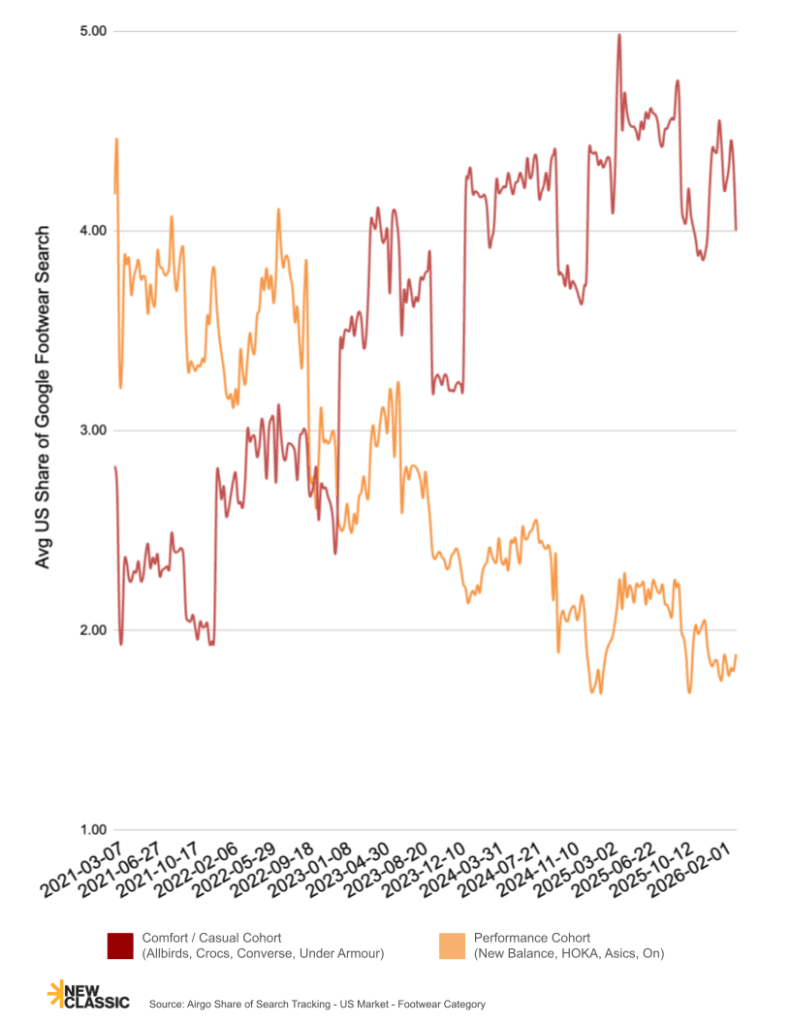
Despite once being valued at $4bn in 2021, shoe brand Allbirds sold this week for $39m, completing a precipitous decline for the Silicon Valley beloved shoe brand. What went wrong? There are many factors that contributed to Allbirds collapse, but search activity from Airgo tracking shows the vibe shift in the footwear category that helped drive the brands losses. Allbirds, similar to Crocs, Converse and other casual / comfort brands, saw a peak in 2022 that’s been declining since (the chart above shows average SOS for similar brands in the cohort). In their place, New Balance, HOKA, Asics and On (performance based brands) have seen a mirror image of growth. As the market moved out of the pandemic and away from comfort cues, Allbirds seemingly couldn’t keep up with changing tastes.
// Ads You Might Have Missed:
1.) ‘Join the Good Side’ – Triodos Bank:
While many consumers will say they care about ethical issues, and even shop in a way that reflects this – fewer consider how their investment and banking behaviors align to these beliefs. Positive impact focused brand Triodos Bank has launched a new campaign, ‘Join the Good Side’ that aims to change this and get customers to act on their good intentions when it comes to financial decisions. Rolling out in the UK, Netherlands, Belgium and Spain, the campaign aims to drive consumers to switch banks, by getting them to focus on a fewer, bigger crisis over the everyday. In a series of ads that talk about everyday challenges, Triodos asks consumers to instead focus on the big issues that an ethical bank switch can help address – from big oil to deforestation.
Eschewing the potentially ‘preachy’ approach normally taken by ethical finance, aiming to make a banking switch seem like a grand, necessary gesture – Triodos anchors the swap in the everyday, making it seem easy and normal. The pragmatic approach recognizes an intent to action gap, that elevating a potential switch may unintentionally feed. Instead, it wants consumers to know that a simple action can still have bigger consequences.
2.) ‘One Pound Rides’ – Human Forest:
UK bikeshare brand Forest (previously Human Forest) has gone deep into UK pop-culture to promote their One pound bike ride promotion, tapping 2012 X-Factor contestant Muhammad Shahid Nazir, famous for his ‘One Pound Fish’ song. Despite being 13 years since the original hit, the brand commits fully to the song and its promotional link – leaving some confused but others surprised by a deep cut reference. As Nazir still performs, the ad leans into his act to include him in the gag vs. erring too opportunistically. As nostalgic campaigns begin to further jumble everything from 1990 to 2015 together, pop culture references that go deeper into the internet and pop culture become more niche. Similar to Ryan Reynolds and Maximum Effort’s love of obscure 90s references, Forest’s in-house ad acknowledges that what’s taken long term hold in the British psyche isn’t always rational. Now if someone can give M&S Romford or Bristol’s Urban Tandoor the extended internet fame they deserve.
3.) ‘Pickelback’ – Cheetos:
Cheetos’ decision to bring back their limited edition ‘Flaming Hot Dill Pickle’ flavour not only inspired an unlikely collaboration between Megan Thee Stallion and Nickelback (based admirably on a ‘pickleback’ pun), it also sparked an interesting use of the brand’s assets. Alongside a bigger budget music video, the brand has auctioned off celebrity merchandise from the shoot, all featuring an unlikely brand asset in the form of ‘cheeto dust’ on each item. The orange celebrity fingerprints don’t seem to have hurt the value, items are going for $5k+ currently, but it does show how a brand’s assets can go beyond a logo to what consumers really associate with the brand or product.
4.) ‘Jersey Swap’ – Canada Soccer:
Italy’s failure to qualify for a third successive World Cup didn’t just spark aggressive debates in Italy’s parliament, it also inspired a genius move from Canada soccer. Recognizing that the country has a population of Italian fans without a team for this year’s FIFA World Cup, the soccer committee offered a swap, allowing fans to exchange their Italy jerseys for Canadian ones. The simple promotion underscores the wider opportunities in this year’s tournament, capturing fans as their teams disappoint, exit or fail to begin. Fandom may be life long, but tactical deviations to ‘backup’ teams are a timeless moment for any tournament. As one of the three host nations, Canada may hope to pick up other supporters through some surprising ideas on and off the pitch.
5.) ‘Life Needs a Biscuit’ – Griffins:
Biscuit brand Griffins has a 150 year history in New Zealand, making it part of the everyday lives of a wide swath of the population. However, instead of banking on their heritage, the brand has taken a page out of documentary series ‘Life in a Day’ and created 24 mini-docs featuring the stories of 24 different New Zealanders. From marching bands to the recently separated, each tackles the reality and quirks of everyday life that occurs around the brand, with a realism that heritage plays often gloss over. Similarly to IKEA’s 2025 product ads which tackled hard, but realistic topics, like death and infertility – Griffins jumps head first into the lives the brand has integrated itself into over the last 150 years.
// Sunday Snippets
// Marketing & Advertising //
– Creative Bloq wraps up brand April Fools jokes [Ads]
– HOKA Thailand staged a race on a go-kart circuit to launch the HOKA Mach 7 [Sports]
– Liquid Death partners with Taylor Morrison to give away a house with ‘Liquid Death’ instead of a water supply [Food]
– Honda Australia straps a record player to the top of its new hybrid CR-V to prove how smooth the ride is [Auto]
– Burger King Brazil launches a social experiment with a smaller whopper to take aim at the competition [QSR]
– Mike’s Hard Lemonade relaunches with a campaign featuring talking lemons [Food]
– Publicis Groupe to acquire 160over90 to expand sports marketing offering [Agencies]
– Sephora and F1 Academy launch partnership [Sports]
– Nike exits boutique fitness, closing its Nike Studio locations [Sports]
– One Piece’s Tony Tony Chopper has been appointed as an official MSF / Doctors Without Borders supporter. He might be a reindeer, but he is a doctor [Charity]
– Pepsi pulls Wireless Festival in London sponsorship after Ye (Kanye West) booking [Music]
– Missing People pushes back on the disconnect between the public’s love of true crime and lower engagement with helping real victims [Ads]
// Technology & Media //
– Cameo partners with TikTok creators to allow integration in the social app [Social Media]
– TikTok has ambitions to offer greater banking services in Brazil [Social Media]
– Meta introduces prescription versions of its Meta Rayban wearable [Wearables]
– Is America’s AI boom leaving the rest of the world behind? [AI]
– Australia accuses platforms of not fully complying with the child account ban [Social Media]
– Actress Hannah Einbinder takes aim at AI creators as ‘losers’ [AI]
– Even in space, astronauts struggle with Microsoft Outlook [Tech]
– Google launches Veo 3.1 lite, offering cheaper AI video generation [AI]
– Two guys made a compass that always points to Olive Garden in Times Square [QSR]
– Anthropic has published new research on the impact of ‘emotion’ in priming AI response [AI]
– Pew finds 62% of Americans usually don’t end up reading most of the email newsletters they receive. Obviously this one is an exception [Media]
// Life & Culture //
– Few Brits see any party as prioritizing cost of living [Politics]
– Marks & Spencer debuts clothing line in the US through Nordstrom [Fashion]
– Why does the manosphere revere the ‘pilates girl’? [Culture]
– In unrelated news, a ‘wild west’ reformer pilates boom has created a spike in UK injuries [Fitness]
– In another instance of ‘Simpsons did it first’, the Texas Rangers are selling a ‘Nacho Hat’ [Sports]
– US Gen Z are increasingly choosing staycations in the face of rising costs [Travel]
– Healthcare jobs, especially nursing, have become a reliable path to middle-class US prosperity [Work]
– Runners are increasingly taking gels while giving birth [Sports]
– Inflation comes for the Icelandic Hot Dog [Food]
– ‘Momager’ Kris Jenner has become an unlikely digital lucky charm on Chinese social media [Culture]
– Blackpink’s Lisa announces a 2026 Vegas residency, a first for a K-Pop star [Music]
// Related Issues
– Social Media’s Slip Away From Socialising
– Will AI Writing Kill the Digression?
– Spotify’s “Real Fans” Bet vs. Google’s Forced AI Remixes
// Until Next Sunday
As always, let me know what you think by email (dubose@newclassic.agency), website or on LinkedIn.
You can also listen to an audio summary and discussion of each week’s newsletter on Spotify. We’re also on TikTok!