In this issue of Sunday Strategy, we look at six stories to think about next week, including: being paid in potential, war and deep fakes, TikTok’s fast moving nostalgia, Gap – closing the gap, intentional friction and OpenAI’s potential enterprise pivot.
In addition, we have ads from: HP, Fortnite, Coinbase, Huggies, AXA and CoorDown.
// Stories of the Week:
1.) Are We Ok to Be Paid in Potential?
With heavier AI usage in work, can tokens become compensation? Jensen Huang’s proposal this week that Nvidia engineers receive an AI token budget on top of their base salary sounds generous until you sit with the implication: employees would bear the cost of their own amplified productivity. With many engineers already burning through AI tokens at a rate that potentially exceeds their salary, the idea is logical – fewer people doing more work, powered by tools they’re incentivised to use efficiently. Companies removing the cost of personal innovation and potentially swaying employees over with greater ‘budgets’. But the wider question underneath this – is who should own the cost of AI-amplified productivity: employer or employee?
There is a talent paradox in AI disrupted industries, lower headcount but higher need for exceptional talent. Amplifying productivity with AI seems to be one answer to this split, leaving less employees able to do more work – but should the token usage to resolve this paradox be their responsibility? Tokens as compensation seems like one answer to that gap, until you ask what happens to the trained agents and processes an employee builds with those tokens when they leave. Tokens only work equitably as pay if the output of those tokens is portable. Otherwise the model risks bonusing the carpenter with a better hammer. As TechCrunch notes, tokens don’t look much like a compensation opportunity from this angle. They look like the new cost of doing business, quietly shifted onto the people doing it in a way that isn’t that different from other sectors.
2.) Disinformation 2.0: War & Deep Fakes.
War has always been a battle for owning the narrative and leveraging confusion as a weapon, but the conflict in Iran is the first of a new age where AI tools are being leveraged to make fabrication indistinguishable from fact at scale. Since the beginning of the war in late February, AI created videos depicting soldiers, destroyed cities and buildings falsely ablaze have captured millions of views, many with verified ticks on platforms like X. A BBC verify investigation found a widely shared satellite image of a destroyed US base was a ‘shallow fake’ – a real image edited with Google AI. Coupled with accusations that even virtual influencers are being faked to influence opinions on the conflict and we face disinformation 2.0 – war’s age old tactics being upgraded through AI.
The consequence of this isn’t just confusion, it’s a deeper polarization and a detachment from the consequences of conflict. As AI researcher Rumman Chowdhury notes, “most Americans are likely entering with low information and biased information – fake media only compounds and confuses this”. This disconnect allows war to become even more ‘like a video game’ (as described recently by the Pope) that is devoid of human consequence and consideration. When every image is potentially faked, nothing can be trusted to help construct real opinions or fuel real decisions. The only reality is for those asked to deliver force or those experiencing it.
3.) TikTok’s Fast Moving Nostalgia.
For Gen Z, TikTok risks becoming an empty habit rather than a destination. The Harris Poll’s ‘TikTok Troubles’ report finds that 79% of Gen Z users miss earlier versions of the platform, specifically missing a time with: fewer ads and brands (41%), raw unfiltered content (34%), and a pre-TikTok Shop feed (33%). The nostalgia has changed the feeling of the platform, as 53% say the platform feels more commercial than a year ago and 72% say content now feels staged and performative.
The commercialisation of social platforms is hardly new, but it cuts deeper for TikTok than for most. Where Facebook sold connection and Instagram sold aspiration, TikTok’s founding promise was uncanny algorithmic relevance… the sense that the feed knew you better than you knew yourself. When that feed fills with brand deals and shop placements, it doesn’t just feel cluttered. It feels like a betrayal of the specific thing that made the platform worth opening. As Harris Poll’s Chief Strategy Officer put it: ‘Gen Z is still showing up every day, but they’re showing up skeptical and nostalgic for a version of the platform that’s already gone. That’s not loyalty, that’s a habit. And habits break.’
4.) How Gap is Trying to Get Its Cool Back
Gap has spent three years becoming more buyable as a brand, but is the product reality keeping pace with cultural impact? The brand’s numbers are genuinely encouraging: comparable sales up 6% in fiscal 2025, a climb from tenth to sixth in the US denim category in two years, and a string of music-video campaigns that have given the brand more cultural presence than it has had since the 90s. CEO Richard Dickson, the architect of Barbie’s revival at Mattel, has described the strategy as ‘Fashiontainment’, hiring a former Paramount executive as Gap’s first Chief Entertainment Officer and opening a Sunset Boulevard office to anchor the brand’s entertainment ambitions.
However, as the Economist piece below asks, are audiences showing up for Gap or for the content Gap is funding? Cultural impact and retail sales are connected, but potentially different outcomes. Gap is easier to notice than it was three years ago, but is it more compelling to buy?
Read More Here.
5.) Intentional Friction and Saved Cows
Despite the defining design principle of the last decade being to remove friction, ‘friction-maxxing’ as named in The Cut, Guardian and BBC is having a moment – as people deliberately introduce and appreciate difficulty, slowness and effort against ubiquitous convenience. The March 13th conclusion of MSCHF’s ‘Our Cow Angus’, a two year art project in which the collective pre-sold a live cow as 1,200 hamburgers and four leather bags – with users able to save its life via a ‘remorse portal’ if 50% of tokens were returned, is one example of friction as a product. The tension, difficulty and long running suspense of the project shows how an increasingly instantaneous and bite sized culture is rife for contrast. When difficulty is removed from everything we do as consumers, from shopping through to impact – something that lays it bare in front of us stands out.
6.) OpenAI’s Enterprise Pivot and Catch-Up
The rumours of OpenAI’s demise may be exaggerated, but the organisation faces increasing challenges from Anthropic’s growth and relentless release schedule. A vibe change has occurred and OpenAI has been left trying to see if a stopgap exists, as its app market share fell from 69.1% in January 2025 to 45.3% in early 2026, driven by model commoditisation. Inference costs have been falling at a median rate of 5-10x per year for frontier models, triggering a global AI price war that hasn’t stopped. When the underlying technology becomes more like a utility, the model alone stops being the competitive advantage.
OpenAI’s response is to pivot aggressively to enterprise, abandoning its sprawling “series of startups” approach and narrowing to coding tools and business customers, with Fidji Simo framing the goal as turning 900 million users into “high-compute users” by transforming ChatGPT into a productivity tool.The bet is that enterprise creates switching costs that consumers don’t have: embedded workflows, proprietary data, compliance infrastructure.The problem is that Anthropic already holds a 40% enterprise LLM market share, built by refusing to chase audio, image and video generation and staying focused on the enterprise and coding market.As Sherwood put it, “OpenAI has been shipping everything, Anthropic is perfecting one thing”. OpenAI is arriving at the conclusion to focus later and with greater funding, but now chasing a lead Anthropic has spent two years building.
Read More Here.
// Ads You Might Have Missed:
1.) ‘Your Way Out’ – Coinbase:
Can a brand that has spent years trying to normalize Crypto now convince you it’s still rebellious? Coinbase’s recent ad, launched during the Oscars, features an NPC (Non Playable Character) breaking free of a pre-programmed financial world. As he escapes, his appearance becomes more human – with the traditional financial system shown as a cage and cryptocurrency as the door. While the execution is flawless, from lo-fi PS2 aesthetics combined with practical sets, the proposition may have a credibility problem. Cryptocurrency is no longer a fringe rebellion, it has institutional banking, government ETF approval and a pro-policy administration. It might actually be a little boring, especially as the escape route it offers is arguably from a new part of the establishment.
2.) ‘Expensive Sh*t’ – Huggies:
Can the affordability crisis help sell diapers? Huggies thinks so and puts an $89k Turkish rug in the line of fire of eighteen well fed babies to prove it. ‘Expensive Sh*t’ is a live stream featuring eighteen just fed babies, crawling across nearly half a million dollars worth of luxury goods. The ‘Life Styles of the Rich and Famous’ element to it makes a table-stakes category demonstration a bit more drama filled, and positions blow-out protection as financial protection.
3.) ‘Escape Bullying’ – AXA:
Can you manufacture empathy through experience? AXA and Publicis Groupe Belgium have turned the concept of school bullying into a physical escape game. It follows the story of Sacha, a 14-year-old whose backpack has been thrown into the school toilets, moving players backwards through key locations to uncover how a seemingly harmless joke can escalate into sustained harm. Developed with anti-bullying organisation Kies Kleur tegen Pesten, the experience uses puzzles and clues to highlight warning signs and the role bystanders play – running for nine months in Brussels, alongside an online point-and-click version. The experience delivers the message in a way that asks people to experience over just hearing about bullying.
4.) ‘Printable Billboard’ – HP:
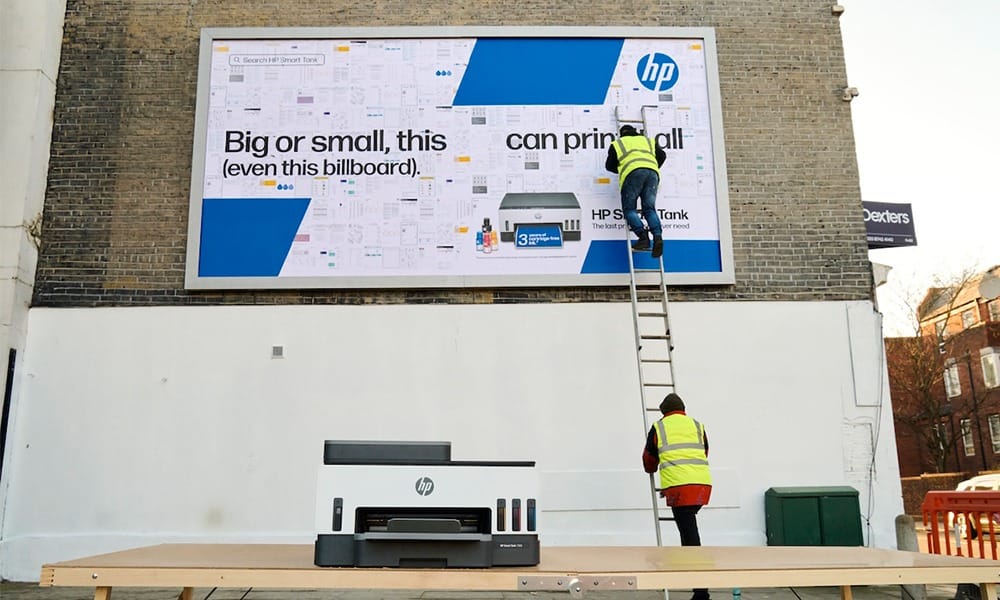
Printers don’t get a lot of love until you need one. Known more for the spiralling cost of ink than for quality in recent times, HP took a novel approach to drive interest in its new ‘Smart Tank’ cartridge free series. It printed out the billboard to promote it. Claiming three years of cartridge free ink use, the printer created its own OOH site in South London, using 319 individual A4 sheets printed live on the street. The activation may make professional printers shudder, but its creation and the content around it does longevity better than normal printer advertising.
5.) ‘Spawn Island Manager’ – Fortnite:
What happens to video game levels when the players move on? It’s a rich question answered by everyone from Captain Nintendo to Wreck It Ralph and a recent Xbox ad – with Fortnite as the latest to talk about the staff behind the game. To promote Fortnite: Showdown, ‘Please Don’t Destroy’ and SNL’s Martin Herlihy has been enlisted as manager of ‘Spawn Island’ the waiting zone for players before they head off in the battle bus. Touching on everything from coordinated dances to a litany of ‘Ice Spices’ (a blizzard of?) – the quick ad highlights enough fortnite references to get new and old players to think fondly about the game.
6.) ‘Just Evolve’ – CoorDown:
When shame fails, what else can drive social change? Amongst a resurgence of the use of the ‘r-word’, CoorDown’s ‘Just Evolve’, launching on World Down Syndrome Day, argues the word isn’t just shameful, it’s outdated. Positioning those using it as behind the times, vs. being a bad person, aims to bring people in vs. accuse. The organization notes that 90% of the time people using the word aim to not directly offend, but that its use still creates a cultural context where disability is associated with failure and marginalization.
// Sunday Snippets
// Marketing & Advertising //
– How Zara fought off H&M and Shein [Fashion]
– Harry’s new bodywash throws some redacted shade at Le Labo [Advertising]
– Thinx enlists internet witchcraft to enchant its latest products [Culture]
– Highsnobiety’s latest report looks at the cultural impact and amplification of FMCG goods [FMCG]
– An AI powered ‘radio time machine’ aims to provide reminiscence therapy [AI]
– It’s a big dill as KFC launches their ‘Pickle Mania’ menu [QSR]
– Polymarket’s ‘Monitoring the Situation’ themed bar experienced a powercut on its opening night. No one saw that coming? [Ads]
// Technology & Media //
– US startup is advertising an AI bully role to test the patience of leading chatbots [AI]
– ChatGPT’s ‘Adult Mode’ could spark a new era of ‘intimate surveillance’ [AI]
– DoorDash’s new Tasks App paints a bleak future for AI gig work [Work]
– Figma’s stock drops 12% in two days as Google launches its new ‘vibe design’ product Stitch [Design]
– Charting the dramatic downfall of NFTs [Web3]
– The NBA’s research and development Instagram account shows how to stretch content beyond core pillars in sport [Social Media]
– Runway becomes the latest AI company to run an ad contest [AI]
– Popmart and Sony announce a Labubu film is on the way [Cinema]
// Life & Culture //
– The MLB is poised to introduce robot umpires & VAR style challenges to the sport this season [Sports]
– The increasing cultural fixation on testosterone [Fitness]
– Is it time to divest from ‘Instagram Politics’? [Culture]
– What does extreme wealth do to the brain? [Finance]
– Crossbreed dogs reportedly show more behavioural problems than pure breed dogs – close your ears Queso the Cavapoo. [Pets]
// Until Next Sunday
As always, let me know what you think by email (dubose@newclassic.agency), website or on LinkedIn.
You can also listen to an audio summary and discussion of each week’s newsletter on Spotify. We’re also on TikTok!