In this long weekend issue of Sunday Strategy, we look at four stories to think about next week, including: Performative AI, SMBs Seeking Growth Not Shelter, Stealing TV and AI Intensifying Work .
In addition, we have ads from: DVLA, Citroen, Greenpeace, Salomon and Old Spice.
// Stories of the Week:
1.) The Performative AI Takeover.
The robots might be coming for us, but it probably doesn’t look like this. As ‘Open Claw’ (previously Moltbot and Open Claude) drove up prices of Mac Mini’s, with users trying to install the AI locally on device, and introduced greater agentic functionality to a range of users, it also generated stories of an instance spending thousands on a user’s credit card, AI-only social network for its itself (Moltbook) and marketplaces for agent only and agent to human work. These may appear like a tipping point for AI in our lives, creating enough coverage to land Open Claw’s creator a job with OpenAI, but they are arguably more theatre than reality.
This part of the ‘AI revolution’ is more performative than performance, showing more about how we think AI should behave than how it actually does. Our need to anthropomorphize the technology is on full show, discussing AI versions of human platforms. The reality is that true AI interaction doesn’t need its own social network, eBay or Monster.com – they wouldn’t even speak in English. Meta’s 2020 shutdown of two AI’s speaking in their own language, or Chinese factories phasing out lights in robot only workplaces are more realistic to what we can expect. Creating unnecessary familiarity amongst AI platforms tells us much more about how we feel about the technology vs. what it might look like soon. Looking for AI in our image, limits us realistically seeing how it’s developing and may fit in our lives.
2.) SMBs are Spending, Not Just Hoping, to Find Growth.
Description. Despite uncertainty, SMBs are increasing plans for marketing spend. 41% of SMBs, across the US, UK, Canada, Australia, and New Zealand, still say inflation and rising costs are a top concern. However, 68% say they plan to spend more on marketing this year – spending to find growth, not just weather the storm.
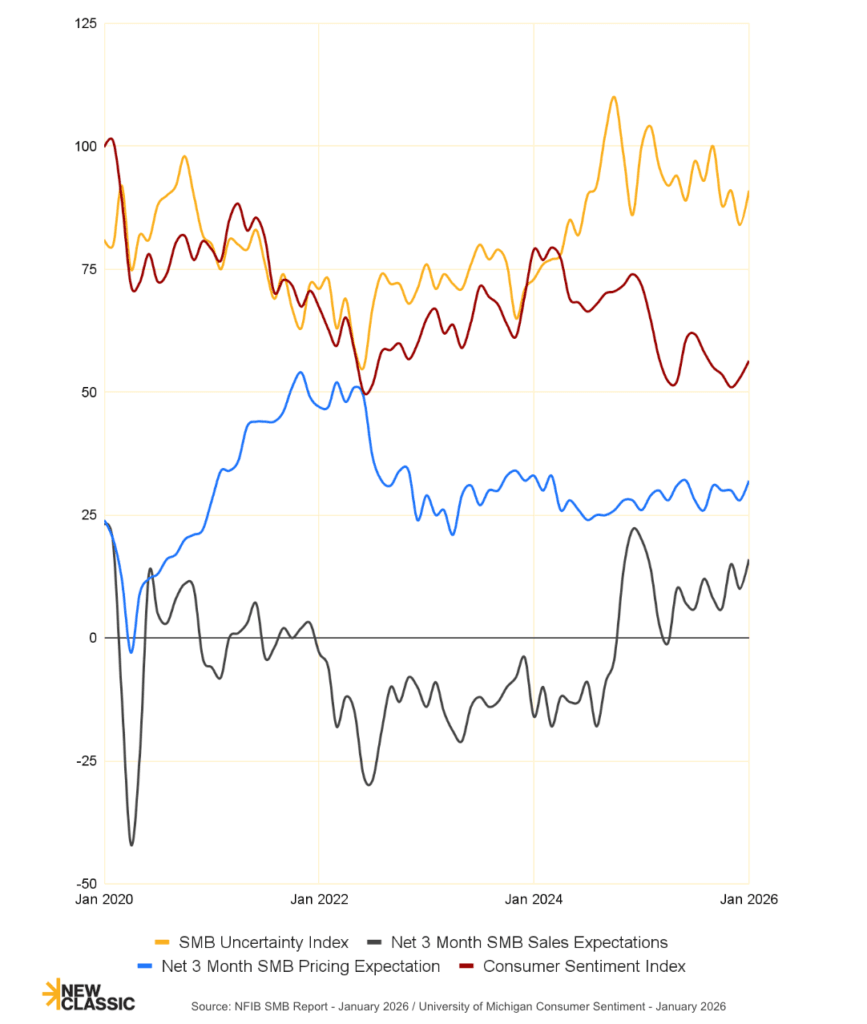
Data from the NFIB in the US paints a similar picture for American SMBs, as pervasive SMB uncertainty hasn’t limited short term ambitions to grow sales or raise prices. The front footed approach to finding growth speaks to a market where many businesses have ‘bunkered’ for long enough and now aim to increasingly face uncertainty head on.
3.) Who Isn’t Stealing TV?
What’s old is seemingly new again, as the streaming industry has inadvertently recreated the conditions that made cable piracy attractive. As streamers raise prices and consumers need more subscriptions across fragmented platforms to follow sports or content, an informal economy around Android based streaming boxes, like SuperBo and vSeeBox are thriving. Sold everywhere from farmer’s markets to Facebook groups, the devices are giving access to 6k+ channels for a single upfront payment.
While piracy and streaming have long been an option, subscription fatigue and platform fragmentation seems to have created a headwind. The devices have helped convert piracy from a technical challenge to a consumer choice and in the process added a new step beyond cord cutting and streaming fatigue. For media owners and streaming platforms, growing similarities in business and operating models look to create similar problems to collectively address.
4.) AI Doesn’t Reduce Work – It Intensifies It.
Success often brings new challenges. A study of New York restaurants once found that those who earned a Michelin star were actually more likely to close than those that didn’t, as expectations and costs created an additional burden to shoulder. A new study from UC Berkeley has similarly found that AI in the workplace didn’t reduce work and liberate workers, it instead intensified work through its assistance.
AI was found to expand the amount of tasks a worker takes on (e.g. product managers now writing assisted code), expand the time spent working (reducing the friction of starting an AI assisted task led to tasks bleeding into wider personal time) and increasing complexity through greater multi-tasking (as AI enabled more ‘threads’ to work on and monitor). These factors are compounded by inflated expectations from companies on what AI assisted employees can deliver – creating a much more intense working experience. As the research shows, productivity gains from AI may be hiding a longer term cost in the form of weakened decision making, burnout and cognitive fatigue. AI adoption planning needs to holistically consider the short and long term cost of success to truly understand how to implement it effectively.
// Ads You Might Have Missed:
1.) ‘Clampy’ – DVLA:
How charming can something stuck to your car’s wheels be? The UK’s DVLA’s (Driver’s Vehicle and Licensing Agency) new campaign gives a personality to a wheel clamp. ‘Clampy’ features a wheel clamp lamenting its need to be attached to a wheel, with Leanne forgetting to pay her car tax causing ‘Clampy’ to miss his son’s fifth birthday. With a deadpan delivery and surprising appearance, the ad may not make you want to meet ‘Clampy’, but it reminds you how to avoid him in a way that doesn’t preach or become easily ignorable – mixing compliance messaging with unexpected humor.
2.) ‘Elections 2034’ – Citroen:
In an increasingly uncertain future, what can you count on to still be there 8 years from now? To promote their new 8 year warranty, Citroen claims that while the world may continue to change – it won’t. The ad, featuring a similar refrain to the Black Mirror episode ‘The Waldo Moment’, shows a dachshund running for office and probably winning. The improbable moment serves as a contrast to the warranty’s constance and builds a shared moment of cultural relevance out of modern political chaos.
The ad avoids political commentary for ‘world gone mad’ messaging and with humor, hopes to laugh at the chaos vs. pile on. For an industry that usually makes warranty messaging dry – Citroen makes something more engaging, if a bit of a slow burn.
3.) ‘We Won’t Rest in Peace’ – Greenpeace:
Legacy giving, a lucrative donation source for charities and NGOs where donors leave a gift for an organization, faces the natural tension that comes along with death – that we don’t really want to think about it. Whereas most will soften the existential angst that comes with a legacy giving message through admiration or hopeful optimism, Greenpeace has shown how an edge can be added. Their legacy giving ad, ‘We Won’t Rest in Peace’ positions a gift as a way to keep fighting for the cause after you die, adding an edge and attitude that fits with the charity’s brand. For those that worry about going quietly into the night, Greenpeace offers a way to make sure the legacy you leave fights for what you believe.
4.) ‘Shaping New Futures’ – Salomon:
Outdoor brand Salomon has introduced a new campaign combining the natural and the artificial. “Shaping New Futures” features athletes and discussion of what the future could be, supported by a distinctly artificial and generative feel. The lead video speaks to the potential of the future being found in the between, ‘urban and wild’, ‘innovation and tradition’, ‘technical and natural’ and ‘artificial and authentic’. The use of GenAI would be jarring, but underscores this view of the future well – creating a shoe ad that doesn’t feel anything like a shoe ad. The question still remains if a brand rooted in the beauty of nature, like the French alps, finds itself in a future too far from its past?
5.) ‘Mom Song’ – Old Spice:
Old Spice has brought back its 2014 ‘Mom Song’ advertisement in a new campaign that once again laments a son’s journey to adulthood thanks to Old Spice products. 2026’s ‘Mom Song’ takes 90s nostalgia, in the form of ‘Boys II Men’s ‘End of the Road’ and puts a new spin on the existing ad format. While it’s unlikely many outside of the industry remember the original ad, it shows the versatility of a creative idea that taps into a timeless tension – where parents struggle to see kids growing up. The idea has adapted in execution, while keeping an understanding of what doesn’t change in human behaviour.
// Sunday Snippets
// Marketing & Advertising //
– Travel Oregon shows the breadth of the state as a destination with a new campaign ‘The State of OR’ [Travel]
– WPP to overhaul creative agency structure [Agencies]
– In related news, UK agencies underwent biggest exodus of staff ever in 2025 [Agencies]
– BBH releases a new visual identity, with three complementary personalities and open sourced fonts based on founders [Agencies]
– Carl’s Jr. looks at Svedka’s Super Bowl ad and says, ‘hold my beer’ [Food]
– Ford and Carhartt have partnered to strengthen the ‘essential economy’ of skilled trades [Collab]
// Technology & Media //
– ByteDance’s new AI video model goes viral as China looks for second DeepSeek moment [AI]
– India’s new 3-hour deepfake removal rule: experts urge strict compliance [Media]
– The hottest indie game is about breeding cats with ADHD and dyslexia [Gaming]
– Meta plans to add facial recognition to its smart glasses [Tech]
– Who isn’t peddling a new AI app? [AI]
– Marriott says Google AI mode will process hotel bookings, not just send links [Travel]
– Airbnb claims AI search drives higher conversion rate than Google [Travel]
– Tiktok unveils ‘Local Feeds’ [Social Media]
– Anthropic study shows AI assistance may lower user mastery in coding, but how the AI is used is a large factor [AI]
– Spotify says developers haven’t written a line of code manually since December thanks to AI [AI]
– OpenAI is nuking its 4o Model and Chinese fans aren’t ok [AI]
– Developers speak out about bigotry on gaming platform Steam [Gaming]
// Life & Culture //
– Synthetic media saturation is reshaping how people judge credibility online. [Culture]
– British heritage cuisine is being repackaged as premium, exportable culture in U.S. dining. [Food]
– The internet may look different after you listen to this [Life & Culture]
– Shein and Vinted are disrupting France’s Fashion industry [Fashion]
– New research shows how fashion shopping behavior is becoming more ‘intentional’ [Fashion]
– You may have released a trend report, but have you released a trend repo on Github? [Culture]
– Meat snacks win and popcorn suffers amongst GLP-1 use [Food]
– Amid rain and the earliest start ever, no one finishes the 2026 terror that is the Barkley Marathons [Sport]
// Until Next Sunday
As always, let me know what you think by email (dubose@newclassic.agency), website or on LinkedIn.
You can also listen to an audio summary and discussion of each week’s newsletter on Spotify. We’re also on TikTok!