In this issue of Sunday Strategy, we look at five stories to think about next week, including: Brand Friction vs. Rage Baiting, Shopping on the Scroll, the Algorithmic Risk of Spotify Wrapped, the Rise of Helicopter Friends and the Journalist Problem with Younger Adults.
In addition, we have ads from: Apple, Cooper’s Brewery, Plan International, Glad and Greyhounds as Pets.
// Stories of the Week:
1.) How Much is Too Much, Brand Friction?
It’s often been said that the worst thing a brand can be is ignored. While brand managers in the middle of a backlash may disagree, brands that capture attention experience a type of ‘cultural friction’ as a byproduct. However, no brand can appeal to everyone and in a time where 2025’s Oxford word of the year is ‘rage bait’, that attention is sometimes as negative as it is positive.
While brands like Cracker Barrel and Jaguar found themselves rubbing certain audiences the wrong way with recent rebrands, others such as American Eagle and Friend turned into the friction. The line between positive friction and brand trolling is a fine one though. Startups like Artisan, Friend and Cluely see trolling as a way to cut through the noise, but may run the risk (as put in the article below) of marketing where “the product doesn’t matter as much as the response to the product”. In the race to capture attention, brands need to consider what they want that attention for.
A recent ad from Columbia shows the nuanced balance between tension and trolling. Their ‘Expedition Impossible’ ad has challenged ‘Flat Earthers’ to snap a picture at the end of the Earth, getting the company (or a $100k of it at least) in return. ‘Flat Earthers’ may be an easier target than others in culture, but for a brand obsessed with the wonders of the natural world, they’re relevant. However, despite the ease of the target, the brand doesn’t punch down too hard, finding a foil over punching down and viciously trolling. The beliefs behind the brand create a friction that explains why this conflict exists – vs. seemingly picking a random fight.
2.) Shopping on the Scroll
Headlines like ‘Gen Z has broken the marketing funnel’ often remind me of a BBH Labs’ piece, which showed that crossworders and people who floss have more group cohesion than ‘Gen Z’. However, as shopping changes based on social media, there are undeniable shifts amongst a predominantly younger user base, in how products are discovered and purchased.
Vogue and Archrival’s new research shows the impact of social shopping on ‘Gen Z’, highlighting that shopping while scrolling on sites like TikTok, platforms like TikTok shop have made purchase easier but also potentially ‘mindless’ and automatic. The shorter gap between discovery to purchase means an immediate reaction, but also less emotional investment. It gives rise to dupe culture and a greater perceived risk that others have hopped on the same trend. It also creates an opportunity for non-social channels to own a more friction filled, unique or mindful shopping experience.
3.) Spotify Wrapped, Music Age & the Algorithmic Perspective.
Spotify’s annual ‘Spotify Wrapped’ has dropped, alongside an ad featuring everyone from Sammy Vriji to Lewis Capaldi and Jade, and with it one of the best continuing examples of data storytelling. While listeners are sharing what artists they favored in the last year and the brand uses it as a platform to talk about popular artists and listening behavior (Bad Bunny dethroned Taylor Swift as the most popular artist of 2025) – a new age feature has sparked a small bit of controversy.
Alongside most popular artists and genres, 2025’s entry saw listeners receive a ‘listening age’ based on the type of music they listened to. While celebrities like Charli XCX (75) and Grimes (92) got ages much higher than their actuals, not everyone has taken to being called ‘old’ before their time. Tapping into our own sense of mortality, and cultural relevance, to spark discussion and (potentially ‘rage bait), Spotify also has shown the interesting challenge of taking an ‘algorithmic perspective’ on our lives and behavior.
We don’t often see ourselves as we are, but instead how we’d like to be. Sadly, data doesn’t share this potential delusion and often runs the risk of sharing some uncomfortable truths with us. Being called ‘old’ by Spotify isn’t a mortal emotional wound, but as we hand over more data to AI and insight platforms, we risk a similar, but worse, reaction to hard truths from artificial financial or medical advisors.
4.) The Rise of Helicopter Friends
As younger generations age, are helicopter parents being replaced by helicopter friends? The Cut looks at the increase in surveillance and tracking as a measure of care amongst younger friend groups – where sharing locations through Find My Friends, Life 360 and others has shifted from something parents requested, to something friends offer each other. As intimacy becomes more entwined with information sharing and constant availability, college students that grew up being monitored by anxious parents are now filling the gap for each other.
However, as location sharing becomes a relationship and friendship milestone, are we losing independence in our increasing interconnection with each other? Looking out for each other in a challenging world is the nature of friendship, but are we violating some of the norms of independent adulthood in the process?
// Charts of the Week: The Problem with Journalists and Younger Adults
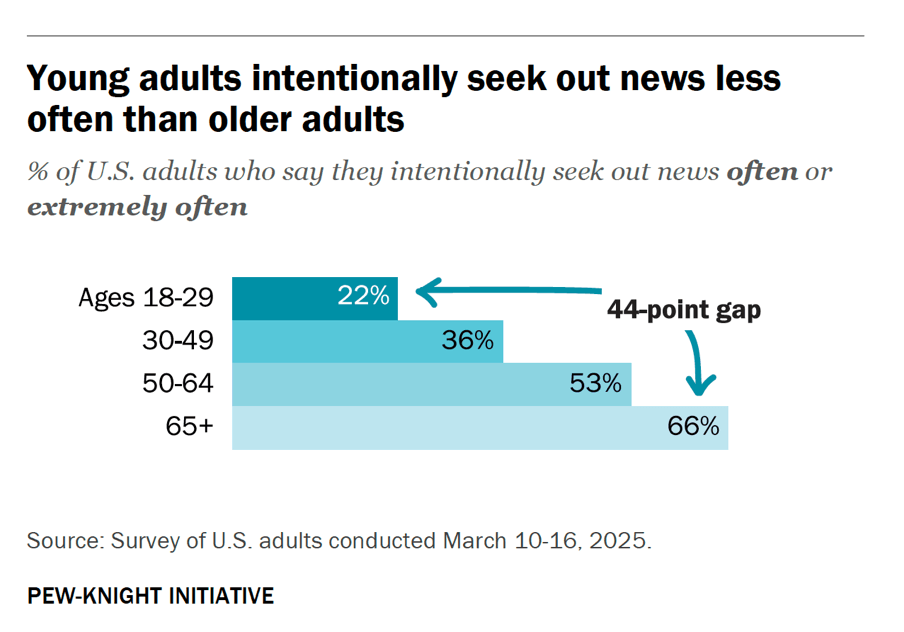
Younger audiences’ views of news and journalism are changing – seeing a broader, potentially more negative, view of journalists amidst shifts to news from social media. Pew’s new ‘Younger Adults and the Future of News’ research shows the distinctive ways 18-29 are engaging with news: being less likely to follow local and national news, less likely to seek out news often, less likely to seek out political news (30% say they come across it because they’re looking for it) and most likely to get news from social media (76% vs. 46% of 50-64s).
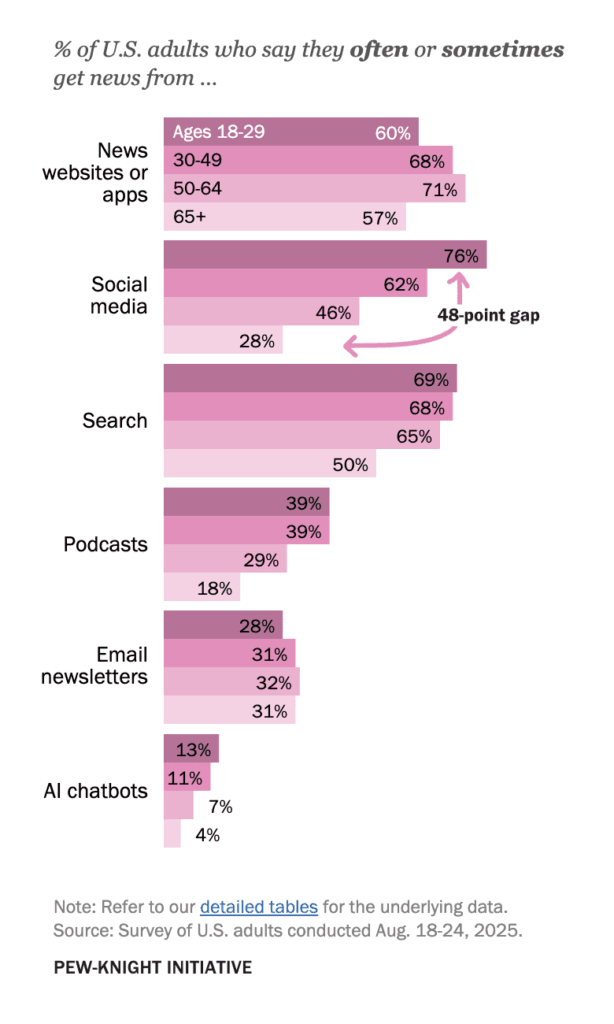
While younger audiences still get news from news websites (60% of 18-29s do so sometimes / often), news behaviors skew online vs. print (only 18% of 18-29s get news sometimes / often from print sources) Integration of social media and influencers into news websites may have blurred the line between journalist and influencer, magnifying the wider shift towards news editorial and degrading trust in journalism.
Recent research from ‘The News Literacy Project’ shows that younger audiences are more negative about journalists in general. 37% of teens, when asked, provided negative feedback when asked what journalists do well, with concerns around a lack of context and distrust. When asked to name a movie or TV franchise that reminds them of ‘journalism’, few teens could – naming Spiderman and Anchorman most popularly. Wider narratives around ‘fake news’ may have combined with a broader definition of who a journalist is for younger audiences – lumping traditional journalists and social media influencers together in a group of lowered expectations.
// Ads You Might Have Missed:
1.) “I’m Not Remarkable” – Apple:
Apple’s latest ad about accessibility tackles the ‘othering’ of disability head-on. “I’m Not Remarkable” features a musical number about how its technology and accessibility features help people with disabilities study and succeed at college, putting students with disabilities as the musical talent. However, while similar ads skew towards admiration, the brand acknowledges (explicitly in the song) that ‘admiration sometimes smells a bit like pity’ and instead focuses on showing how technology helps everyone, regardless of ability, be as unique as each other.
The insight around the beatification of disability in society rings true everywhere, where we often see people as only their disability and strip them of wider depth, agency and flaws – but it rings especially true for university. Apple shows the best of technology’s potential, not to help everyone be perfect, but to help everyone explore, express themselves and learn.
2.) ‘Santa’s Little Helper’ – Greyhounds as Pets:
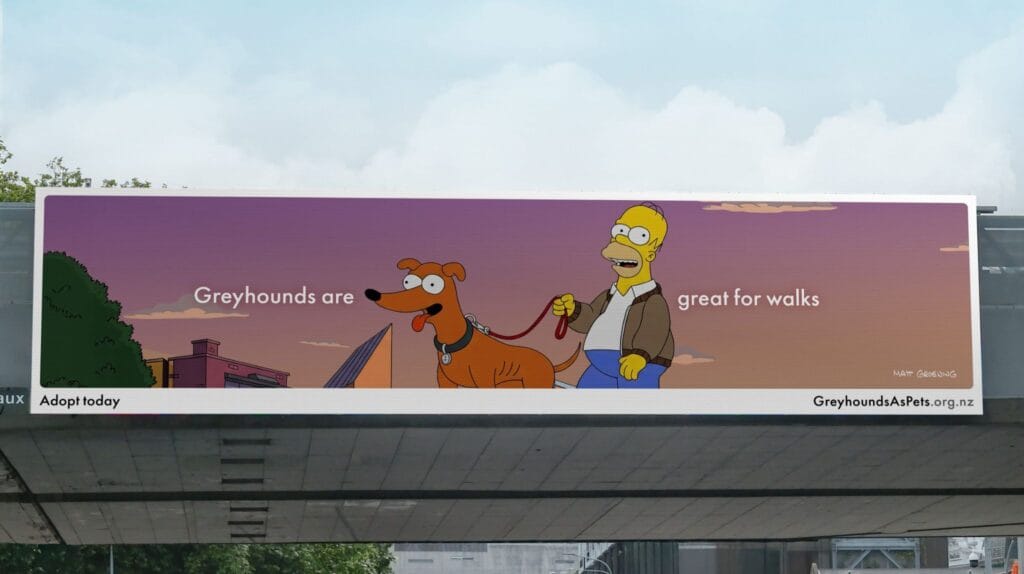
While the Simpsons have a seemingly uncanny knack to predict the future, potentially due to a 36 season runtime that provides footage for almost every known possibility – it’s rarer that the show tries to shape the present. While ‘Who Shot Mr. Burns’ captured viewers imaginations and culture back in 1995, a new campaign in New Zealand uses an unlikely character to change attitudes towards dog adoption.
‘Santa’s Little Helper’ has been the Simpsons’ dog since the first episode of the show on FOX in 1989, as the family adopts a greyhound Homer lost his Christmas bonus on during a long shot bet. Since then, the dog has been a constant presence in episodes and now, also in a New Zealand campaign to show the value of Greyhounds as pets.
With greyhound racing coming to an end in 2026 in the country, over 2,000 racing dogs will need a home and billboards are featuring moments from the Simpsons’ in a hope that others will mirror the family’s 1989 adoption. With 90s cultural nostalgia at a peak, and the Simpsons beyond ubiquity in many markets, the campaign finds a wildly relevant metaphor to address the looming issue. Now if we can just find a public transport campaign that needs a monorail (Brockway, Ogdenville and North Haverbrook have the case studies).
3.) ‘How Bad News Hits Girls the Hardest’ – Plan International:
There is no easy way to get people to care about the suffering of children. This may seem paradoxical, as children’s welfare should instinctually spur us into action when threatened, but the reality is different. In a world filled with conflict, suffering and children at risk everyday – we’re often overcome with the gravity of the situation and instead turn away.
Charity marketing often aims to split the difference between showing the importance of a situation, with keeping viewers engaged. Plan International’s latest Norwegian campaign does exactly this while also highlighting the specific focus of the organization, helping girls. Acknowledging a 24 hour news cycle that often brings conflict into our homes, but moves us on before we act or it’s resolved – the charity’s three ads take a remote news setup and slowly zoom in on the girls affected in the background of each. Literally focusing on the focus of the organization in a way that shows a familiar situation, in an unfamiliar way.
4.) ‘For Good Mates’ – Coopers Brewery:
Research shows that middle aged male social circles aren’t just declining, the friendships in them may not have the depth of conversation needed to cover off the topics facing men. Getting men engaged and talking has been the focus of football sponsorships in the UK and skits on SNL in the US, usefully suggesting doctors adopt a podcast format to get men to talk about embarrassing issues.
However, Australian beer brand Coopers has shown we might just need a decent 90s rock beat and some instruments. Their ‘For Good Mates’ ad sees men discussing embarrassing topics and revelations with each other, all within a song and in the process highlights the things we should probably be sharing with our closest friends. The ad features a competition to win a trip for you and your mates to New York City, including a visit to Australian themed bar (and recent Hugh Jackman impromptu concert venue), Old Mates.
5.) ‘I Love Trash’ – Glad:
Does anyone really love trash? Sesame Street’s ‘Oscar the Grouch’ does and Glad trash bags extends his sentiment in an ad remixing his 1974 song ‘I Love Trash’. Moving trash from a negative to the star may still be a bridge too far – but the ad gives it an earnest try. While the ad ends with recognition that nothing will make people love trash as much as Oscar does (he does live in a bin), the partnership seems so natural that it’s surprising it hasn’t happened sooner. Aside from allowing the brand to talk about how it makes an unlovable aspect of daily life tolerable, it taps into the swirling mass of intergenerational nostalgia in a way that makes anyone who grew up with Sesame Street smile. For a brand constantly concerned about private label encroachment, the ad is a vehicle to reinforce rational factors while creating a bit of emotional good will.
// Sunday Snippets
// Marketing & Advertising //
– KFC Spain’s ‘Dragonball Z’ themed meals have sparked an ad campaign where patrons bring the show to life in restaurant [Food]
– in the face of economic challenges for QSR, Subway has resurrected its ‘Sub Club’ loyalty program from its 2005 end – now with the chance to win a bread oven [Loyalty]
– MUG Root Beer launches a cologne for owners who love root beer…and their dogs? [Pets]
– Keurig has launched the ‘Coffee Collective’ – an expert led portfolio of flavours and coffee products [Food]
– Pantone’s color of the year for 2026, ‘Cloud Dancer’, aims to evoke a sense of calm – but are we choosing colors for the world we have or some version of the one we want? [Culture]
– A ‘Focus on Fiber’ and ‘Kitchen Couture’ are parts of Whole Food’s 2026 trend report [Research]
– SKYN takes a scientific approach to talking about couples’ closeness in Japan [Romance]
– US DIY brand Home Depot has launched their World Cup 2026 ad, instantly recognizable in part due to the music from 2012’s P&G’s ‘Thank You Mom’ and the visuals from 2010’s Nike’s ‘Write the Future’ [Sports].
– LEGO and F1 Academy announce a new multi-year partnership [Sports]
– To promote Percy Jackson, Disney has turned a billboard in LA into its own water theme park [Media]
– ALDI launches lickable ‘pigs in blankets’ wrapping paper in the UK [Food]
– Is holiday spending polarizing between the wealthy and deal hunters? [Economics]
// Technology & Media //
– A greater focus on device memory, thanks to AI, may be poised to drive up smartphone prices [Technology]
– Industry publication Little Black Book offers a free pro subscription to all facing redundancy [Media]
– Mondelez is investing heavily in AI generated TV ads [AI]
– AI platform Perplexity and Christiano Ronaldo have announced an investment and partnership [AI]
– Anthropic are launching ‘Anthropic Interviewer’, using AI to interview people, about AI [AI]
– Polymarket’s betting market on the Ukrainian war has led to unauthorized editing of territorial maps of the battlefront online [Culture]
– Netflix’s deal to acquire Warner Bros shocks Wall Street [Media]
– As Meta reportedly moves on, are we seeing the end of the ‘metaverse’ as we know it? [Social Media]
– A government shift is stopping India’s ‘Wifi Whatsapp User’ [Media]
// Life & Culture //
– As ‘Detty December’ grows into a global pilgrimage of diaspora back to West Africa, are growing pains hitting the party? [Travel]
– Despite a sense of greater polarization, recent Gallup research shows a majority of Americans agree on a range of statements when it comes to democracy [Culture]
– KITH’s ‘KITHmas’ Christmas collection ranges from ornaments and cookie jars to…a Gundam Collab? [Culture]
– People are dropping espresso into a Guinness to make a ‘Turbo Guinness’. So now you can be drunk, awake and full. [Food]
– Ganni x Barbour partner again to bring a Scandi British fashion sensibility together for the fourth time [Fashion]
– In an unintentionally apt demonstration of gentrification, Brooklyn’s Wythe diner has been craned out of its Williamsburg location to be used in TV and movies [Culture]
– Maniberg’s latest bedwear collection with Our Legacy takes a lived in feel to new levels [Fashion]
– Beis and Chipotle may seem like an unlikely combination, but a burrito themed duffle bag begs to differ [Fashion]
– Amongst a never ending wave of 90s cultural nostalgia, are we giving Gen X enough cultural credit for their creations? [Culture]
– Artist Beeple has reimagined Musk, Warhol, Bezos and others as robotic, picture pooping dogs for Art Basel in Miami [Art]
// Until Next Sunday
As always, let me know what you think by email (dubose@newclassic.agency), website or on LinkedIn.
You can also listen to an audio summary and discussion of each week’s newsletter on Spotify. We’re also on TikTok!