Generative AI is widening the gap between employees, helping some far more than others — and that effectiveness gap is becoming a management problem. This issue examines it, plus algorithmic nationalism, AI coding vs. AI voice, going wider with category entry points, and moving on from calories.
In addition, we have ads from: IKEA, Dr. Pepper, Canva, the UK Green Party and Jet-Puffed.
// Stories of the Week:
1.) Why Does Generative AI Help Some Employees More Than Others?
Despite greater employee adoption of Generative AI, only 26% of workers in a recent Gallup survey reported creativity gains due to the technology. Why does GenAI help some employees and not others?
The answer lies in how employees think. New research shows that employees with greater ‘metacognition’, the ability to plan, monitor, evaluate and refine thinking, are more likely to see creative gains vs. those that don’t. Stronger metacognition manifests as ongoing reflection, not just planning out steps around a task, but refining and monitoring them based on success. They offload the easier parts of a task to AI and actively engage with the harder parts or ongoing success of the project. Low metacognition leads users to accept the first answer from AI or not check sources – getting ‘faster’ without getting ‘better’ at the task.
The study, currently only run in Chinese consulting firms, needs replication – but it suggests clear implications in how we think about successful AI. ‘Adoption’ isn’t as important as ‘Engagement’ in enterprise settings and ‘automation’ isn’t one size fits all in a complex task when successfully done with AI. Employee mindset matters more than technology, as AI maximises how employees already approach a task rather than reinventing how we work. The cultural narrative of ‘set it and forget it’ AI use may be one of the biggest barriers to companies using it well.
2.) TikTok’s US Deal and Algorithmic Nationalism
After a year of uncertainty around its US presence, TikTok has finalized a deal to operate in the US, backed by a JV involving Oracle, Silver Lake and the Emirati investment firm MGX. The deal sees American users keeping the same app, but with different terms of service and a different ‘algorithm’, trained on US user data.
The algorithmic split may stave off US concerns of foreign influence and propaganda, but it raises questions for creators about global reach, as well as whether TikTok provides a global point of view to US users. Social media has already drifted far from early promises of global connection. Moves like this may signal the further decline of its potential to connect users across borders and cultures.
Trends that once moved quickly across geographic regions or culture might be facing new speed limits. Ironically, the cultural connections created last year when US users joined Rednote during TikTok’s US shutdown, represent what social media promised and what we’re increasingly losing in the modern media landscape.
3.) Will the Population Code with AI Before We Talk To It?
Two recent WSJ pieces capture competing visions for how we adopt AI further into our daily lives: Anthropic’s Claude Code turning developers into AI-assisted programmers vs. audio-first devices pitching a post-screen future. So which sneaks into our lives and ‘AI pills’ us first?
Claude Code’s increasing moment in culture represents augmentation. Developers keep their screens and workflows—they just get a smart assistant. Early adopters report genuine gains with minimal behavior change required. New coders get impact without complexity.
Voice AI hardware demands wholesale transformation. Voice has made in-roads pre-AI, but further growth requires abandoning ingrained habits: pulling out phones, visual confirmation, scrolling. It also faces context problems—coding happens in controlled environments, but voice needs to work everywhere, despite privacy concerns and ambient noise.
History favors least friction. Email overcame mail by being faster, not different. It’s more likely most of us will ‘code’ with AI before abandoning screens—not because voice isn’t powerful, but because augmenting existing behavior always scales faster than replacing it.
4.) Do We Need to Expand How We Think About Category Entry Points?
As Byron Sharp described, ‘One of the Ehrenberg-Bass Institute’s major contributions was to flip marketer attention from what the brand evokes (brand image) to what evokes the brand (mental availability).” However, a recent article in Marketing Week asks an interesting question about the mental availability model – whether association alone determines choice?
The framework suggests brands win by being mentally available when category needs arise (Category Entry Points). Build these associations through consistency and reach, and consumers will choose you. Mental availability assumes any strong association drives selection, but the authors at Everyday People ask what about fitness and suitability?
Are there wider influences on making association actionable, from signalling in media through to social influence? If so, taking a laser view on association strength alone may leave brands associated strongly, but less appropriate for selection.
5.) Are We Moving On From Calories?
As narratives around protein (and increasingly fiber) take hold culturally, and GLP-1 use increases, the way we think about and measure what we eat may be changing. ‘Calorie Counting’ has been a fixation of dieting and health from Weight Watchers’ founding in the 60s through to Oprah and the “Biggest Loser”, but can strong over skinny attitudes displace the calorie metric at its heart?
Shifting away from basic number restrictions to wider conversations about food content, from processing to fiber doesn’t happen overnight. It also doesn’t preclude body dissatisfaction, instead potentially shifting it to different areas. However, a combination of concerns around dangerous food attitudes and disordered eating, as well as changing body and food narratives may be calling time on simplified calorie narratives.
// Ads You Might Have Missed:
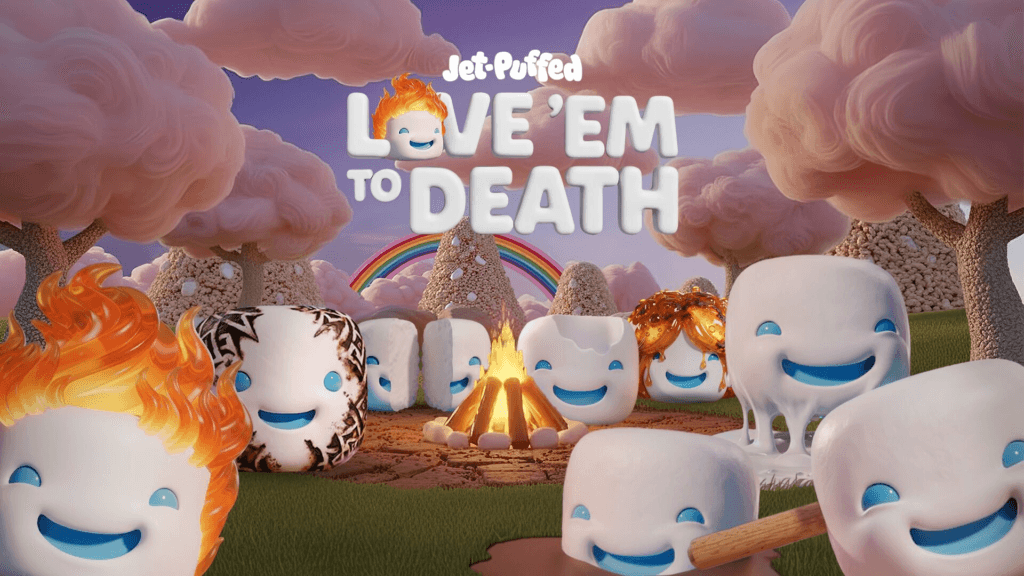
1.) ‘Love’em To Death’ – Jet-Puffed:
Edible food mascots have always sat in-front of an uncomfortable tension. From US grocer Piggly Wiggly’s ‘Pig in a Butcher hat’ to the UK’s Pepperami animal, there’s a natural dissonance in something telling you to consume it. Following the lead of brands like Cinnamon Toast Crunch to turn into the skid, JetPuff marshmallows have taken a self-destructure approach to their latest ad – naming and destroying marshmallows in ways that might evoke terror or campfire nostalgia for smores.
The campaign, ‘Love’em to Death’ aims to give license to destroy each puffy marshmallow as indulgently as you like, but somehow also feels a bit ‘Dumb Ways to Die’. Whether it hits the right tone is an open question, but it does aim to land with a sadistic child in some of us.
2.) ‘Its Good and Nice’ – Dr. Pepper:
Soft drink brand Dr. Pepper turned a homemade jingle posted to TikTok by Romeo Bingham into ads that aired during Monday night’s College Football National Championship. While Dr. Pepper was originally going to air ads featuring its ‘Fansville’ College Football campaign, the shift allowed the brand to elevate a social conversation to a national stage – quickly making Bingham’s ‘Dr. Pepper Baby, Its Good & Nice’ post into a full ad.
The TikTok, originally posted in late December, shows how a brand can do more than take inspiration from social media. Instead, it can use media to elevate authentic content and show an appreciation for its fans. Paid media can become scaffolding for brand content to burn brighter and reach further, similar to previous efforts from brands like TikTok in putting social content to the forefront*.
*I think one shameless self-plug for previous work a quarter is only fair!
3.) ‘How We Make Hope Normal Again’ – UK Green Party:
With political dissatisfaction and growing Reform support in the UK, the Green Party and its leader Zach Polanski are seeing increased support. Similarly to NYC Mayor Zohran Mamdani, the party’s recent communications have taken this opportunity to produce messaging that poses a question on how we live as much as provide a claim for leadership to fix it.
‘How We Make Hope Normal Again’ sees Polanski take an increasing pace literally and in monologue, as he breaks down the anxieties and treadmill of pressure many live on in the UK and further abroad. The sense of dissatisfaction and ‘if this can be the only way’ comes through clearly as he asks how hope can find a place in daily life again, while the delivery does as much to build empathy as the message itself. For a political age that requires showing, not saying that you ‘feel voters pain’, the video does well to empathise while also expanding the Green’s issue base.
4.) ‘Faz Bonito’ – Canva:
Creativity suite Canva has tapped 90s nostalgia in their latest Brazilian campaign, expanding the sentiment of ‘Faz Bonito’ (roughly meaning ‘make it beautiful’) through ads featuring 90s children’s presenter Xuxa. She presents fake products created in Canva (the Xuxa Airfryer or Xuxa sponges), marketed for ‘little adults’ in a way that will evoke nostalgia amongst 90s Brazilian children. In a similar vein to the US 2025 Super Bowl campaign from GoDaddy featuring Walton Goggins (and his Goggle Glasses), the digital creativity suite makes the absurd and intangible real to inspire others to think about doing the same.
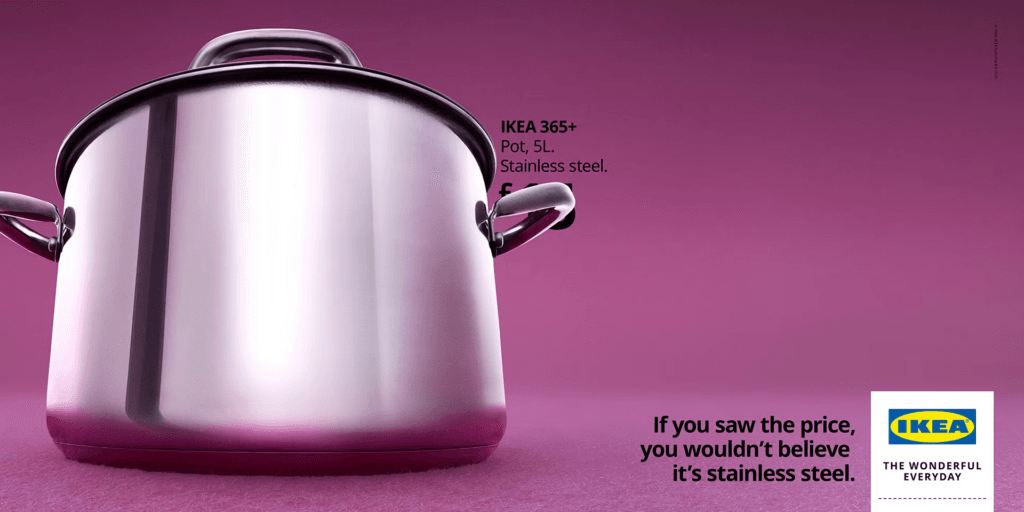
5.) ‘If You Saw the Price’ – IKEA:
Can you provide too much value? A good product at a low price is the stated north star for brands and customers, but often this is seen as a trade-off rather than a goal. Offer consistently low prices and customers question quality. IKEA’s latest UK OOH campaign attempts to head off these concerns by breaking their long-held focus on price-first advertising.
‘If You Saw the Price’ features ads where products (a sofa, a lamp, a chair)literally block out their price tags, with copy suggesting that if you saw the cost, you wouldn’t believe the quality. The executions put product first while still conveying affordability implicitly. For a brand with deep heritage in low prices, strengthening quality credentials offers significant upside with minimal risk. Other value brands navigating similar perception gaps should take note.
Talking about marketing is trivial relative to more serious things going on in the world at the best of times, but the gap now, especially for American readers, may be bigger than usual. If you’re enjoying Sunday Strategy and you’re in the US, consider making a donation to the ACLU and supporting the important work they’re doing.
// Sunday Snippets
// Marketing & Advertising //
– Duolingo drops ‘Bad Bunny 101’ teaching Spanish before artist’s Super Bowl campaign [Music]
– KFC Canada partners with Matty Matheson on a limited edition range and campaign [Food]
– The PGA Tour launches a new sharp-elbowed campaign vs. LIV Golf – ‘Where the Best Belong’ [Sports]
– Marketing Dive’s live blog is tracking the growing number of Super Bowl 60 teasers and announcements [Sports]
– H&M launches fragrance in collaboration with E.L.F. [Collabs]
– Beverage brand Dash rolls out an OOH campaign in the UK for Dry January [Food]
– Choice Hotels continues their three year campaign with Keegan-Michael Key [Travel]
– UK travel brand ‘On the Beach’ wades into the Beckham wedding drama with tactical OOH [Travel]
– Jordan Brand welcomes golfer Tony Finau to the family while destroying a garage door [Sports]
// Technology & Media //
– Shopify merchants to pay 4% on ChatGPT checkout sales [AI]
– Does a rumoured wearable pin fit with the Apple brand? [Tech]
– Charli XCX takes over Sundance Film Festival with her Brat summer mockumentary ‘The Moment’ [Film]
– Microsoft slashes minimum audience sizes for remarketing from 1000 to 100 [Media]
– Meta rolls out threads to users globally [Social Media]
– Is ChatGPT use becoming a relationship dealbreaker? [Romance]
– Microsoft names AI CMO, pushes Intelligence into Ads [AI]
– He may have won the US College Football Championship, but Indiana quarterback Fernando Mendoza had to make it “LinkedIn Official” [Sports]
– ChatGPT rolls out additional age protection and prediction tools [AI]
– OpenAI celebrates companies putting their AI to use with ‘Frontier Builders’ [AI]
– The FT argues we shouldn’t blame AI for job shifts that rate hikes can explain [Work]
– TikTok’s US app has sparked outrage with new TOS collecting precise user data [Social Media]
– Netflix’s march towards greater live programming continues with the reboot of 80s US talent show ‘Star Search’ [Media]
– Google reconsiders how its summarizing headlines with AI [AI]
// Life & Culture //
– Why the winter storm hitting the US this weekend is wilder than normal [Weather]
– Grail’s 2026 marketplace report breaks down rising fashion brands and designers [Fashion]
– Dubai style chewy cookies pick up where Dubai chocolate left off as a South Korea viral food trend [Food]
– Are we seeing the end of executive floors and offices? [Work]
– President Emmanuel Macron’s sunglasses become the unexpected breakout hit of Davos [Fashion]
– Canadian Prime Minister Mark Carney said the “old order is not coming back” in Davos speech [Economics]
– Breaking down Adobe Firefly’s top 2025 visual trends [Design]
– Lululemon puts their ‘see through leggings’ back on sale. With instructions on how to wear them [Fashion]
– Can ‘micro-shifting’ where the 9 to 5 gets broken up into less linear blocks of work succeed in current office culture? [Work]
– The “Marty Supreme” collab hype train hasn’t slowed, with A24 x 47 releasing a line of NY Sports hats, branded in the film’s distinct orange color [Fashion]
– In the Northeast US and looking for guidance on the snow storm? The NY government and some unhinged Labubu images might be what you need [Culture]
– The success of ‘Heated Rivalry’ has reportedly created a 20% increase in NHL tickets – and they say fans used to go for the fights [Sports]
// Related Issues
– Can We Accept Superintelligent AI Assistants?
– Spotify’s “Real Fans” Bet vs. Google’s Forced AI Remixes
– Social Media’s Slip Away From Socialising
// Until Next Sunday
As always, let me know what you think by email (dubose@newclassic.agency), website or on LinkedIn.
You can also listen to an audio summary and discussion of each week’s newsletter on Spotify. We’re also on TikTok!